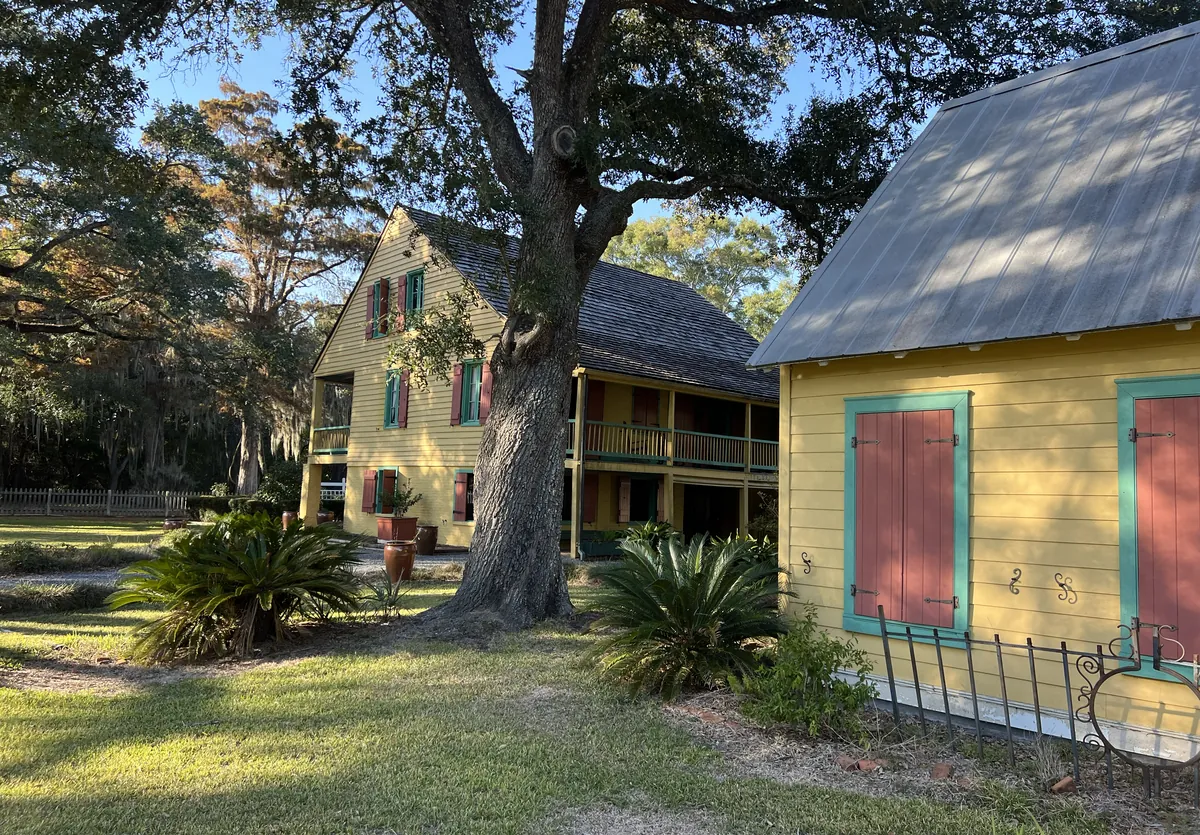
The land itself shaped what would happen here. South of a line of low hills, the terrain flattens into dry prairies and then dissolves — into marshes, bayous, and the slow coastal wetlands that edge the Gulf of Mexico. The Atchafalaya Basin cuts through the middle of it. Rice and sugarcane take the fields where the ground holds. For centuries, the abundance of water and the difficulty of moving through it kept this place half-isolated from the rest of the continent, and that isolation did its work.
The Attakapa were here when Europeans arrived. German settlers preceded the Acadians, putting down roots along what became known as the German Coast as early as 1721. The people who would define the region came later and harder. The Acadians were French-speaking settlers who had built a life along the Bay of Fundy — farmers who engineered dike systems to reclaim coastal land, a colony of perhaps 15,000 by 1755, descended largely from families out of western France bearing surnames still common in south Louisiana today: Broussard, Hébert, LeBlanc, Thibodeaux. When the British won the Seven Years' War and expelled them from what is now Nova Scotia, those families scattered across the Atlantic world. The ones who eventually found Louisiana arrived in 1765. Archaeological work led by Dr. Mark Rees of the University of Louisiana at Lafayette now points to Loreauville, along Bayou Teche, as the likely site of that first settlement — a group of 200 led by Joseph "Beausoleil" Broussard, who received land grants to farm and raise cattle. Thirty-nine of them died of disease within months.
What they built from that beginning, in a country of cypress and Spanish moss that was nothing like Nova Scotia, was something genuinely new. The Acadians intermarried — with Creoles, with the descendants of the gens de couleur libres, with Native peoples, with the Anglo-Americans who came in after the Louisiana Purchase of 1803, and later with Southeast Asian families who arrived in the late 20th century and reshaped the fishing communities. Louisiana was a French colony, then a Spanish one, and the three-tiered social structure it inherited from Latin and Caribbean models allowed for arrangements — like the system of plaçage — that produced a multiracial Creole population of unusual complexity. All of this is in the food and the music and the way people here still understand the word "neighbor."
The French language nearly didn't survive. The Louisiana Constitution of 1921 prohibited speaking it in schools; punishment was corporal. The language went underground, passed through kitchens and front porches rather than classrooms. It endured anyway. In 1968, the state created the Council for the Development of French in Louisiana — CODOFIL — to begin reversing the damage. Three years later, in 1971, Governor Edwin Edwards signed the legislation officially recognizing the 22-parish region as Acadiana, a name that itself arrived sideways: coined first by a Crowley newspaper in 1946, then independently by KATC television in Lafayette in the early 1960s, and fixed into common use when a billing clerk accidentally typed an extra "a" at the end of "Acadian" on an invoice addressed to the station.
A typo named the place. The people had already been building it for two hundred years.