Charlottesville sits in the Virginia Piedmont, in the rolling country between the Blue Ridge Mountains to the west and the Southwest Mountains closer in — a position that made it, from the beginning, a place where roads converged. Three Notch'd Road, the old trade route running from Richmond toward the Shenandoah Valley, passed through the settlement before it was even a town. Geography put Charlottesville at a crossing. Everything else followed from that.
The Virginia Assembly established the town in 1762, with Thomas Walker as its first trustee, and named it for the British queen Charlotte of Mecklenburg-Strelitz. At the time of European settlement, the area had been home to a Monacan village called Monasukapanough. The Monacan were pushed off their land and forced to disperse — to North Carolina, Tennessee, and beyond. The town that replaced their village grew as a market and administrative center for Albemarle County, occupying the kind of middling position that tends to produce durable places: not grand enough to attract occupation, not isolated enough to be ignored.
During the Revolution, the town held the Convention Army prisoner at the Albemarle Barracks between 1779 and 1781. On June 4, 1781, a local named Jack Jouett rode through the night to warn the Virginia Legislature, then meeting at Monticello, of a planned British raid under Colonel Banastre Tarleton — giving the government time to escape. That episode is worth noting not as a footnote but as a pattern: Charlottesville, repeatedly, was the place where consequential things were protected.
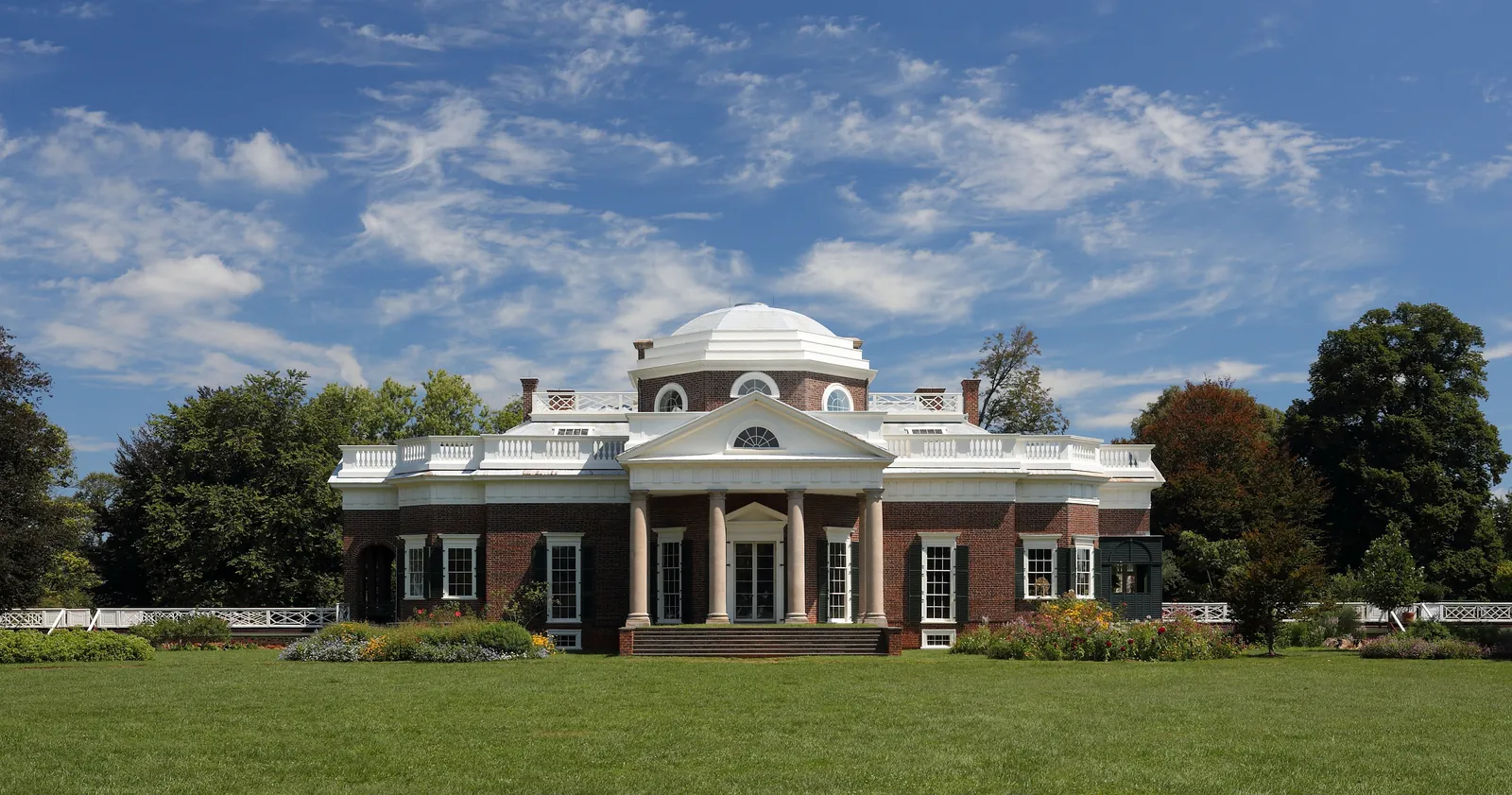
The most consequential thing Jefferson protected here was his idea of a university. The University of Virginia, which he founded, straddles the city's southwestern border and with Monticello — Jefferson's home and plantation three miles southeast of the city — forms a UNESCO World Heritage Site. The Academical Village, which Jefferson designed, centers on the Lawn: a long esplanade anchored by the Rotunda at one end and Old Cabell Hall, designed by Stanford White, at the other. Jefferson's intention was a university organized around knowledge rather than theology — disciplines given equal architectural standing, students and faculty living and working in the same colonnaded complex. That idea shaped the character of the city as firmly as any road or railroad. The university brought students, then permanence, then a culture that has never fully separated itself from the founding argument Jefferson was trying to make.
The railroad arrived in the early 1850s under the Louisa Railroad Company, which became the Virginia Central Railroad and eventually passed into the Chesapeake and Ohio line. The Southern Railway followed, running a north-south route that crossed the C&O's east-west tracks, and Union Station grew up at the junction. The crossing of two rail lines did for Charlottesville's economy what Three Notch'd Road had done a century earlier: it made the city a place where things met. Hotels, repair shops, and workers' housing followed.
The city's record carries damage that belongs in any honest account. Jim Crow segregated Charlottesville's schools, parks, and businesses. In 1965, the city government razed Vinegar Hill — the downtown African American neighborhood — displacing 130 households, five Black-owned businesses, and a church in the name of urban renewal. The land sat empty for more than a decade. And in August 2017, the Unite the Right rally, organized to protest the removal of a Confederate statue, ended with a white nationalist driving a car into a crowd of counter-protesters, killing Heather Heyer and injuring nineteen others. Charlottesville did not choose to become a symbol of that moment. It became one anyway.
What the city made, across that full history, is harder to summarize and more worth understanding. Two presidents — Thomas Jefferson and James Monroe — called it home. A third, James Madison, grew up twenty-six miles away. The university Jefferson built here is still the organizing fact of the place: its 20,000 students, its research institutions, its medical center, the concentrated intellectual life that has made Charlottesville, per capita, one of the most credentialed small cities in the country. The Dave Matthews Band launched from here. Rita Dove wrote here. The Downtown Mall — one of the longest outdoor pedestrian malls in the country — runs through a commercial center that survived intact because the city, for much of the twentieth century, lacked the money to tear it down. Charlottesville has been, by turns, a colonial waypoint, a presidential seat, a rail junction, a university town, and a contested public square. The thread connecting all of it is the same one Jefferson was pulling when he put a Rotunda on a hillside and called it a village: the belief that what you build in a place outlasts whatever else happens there.