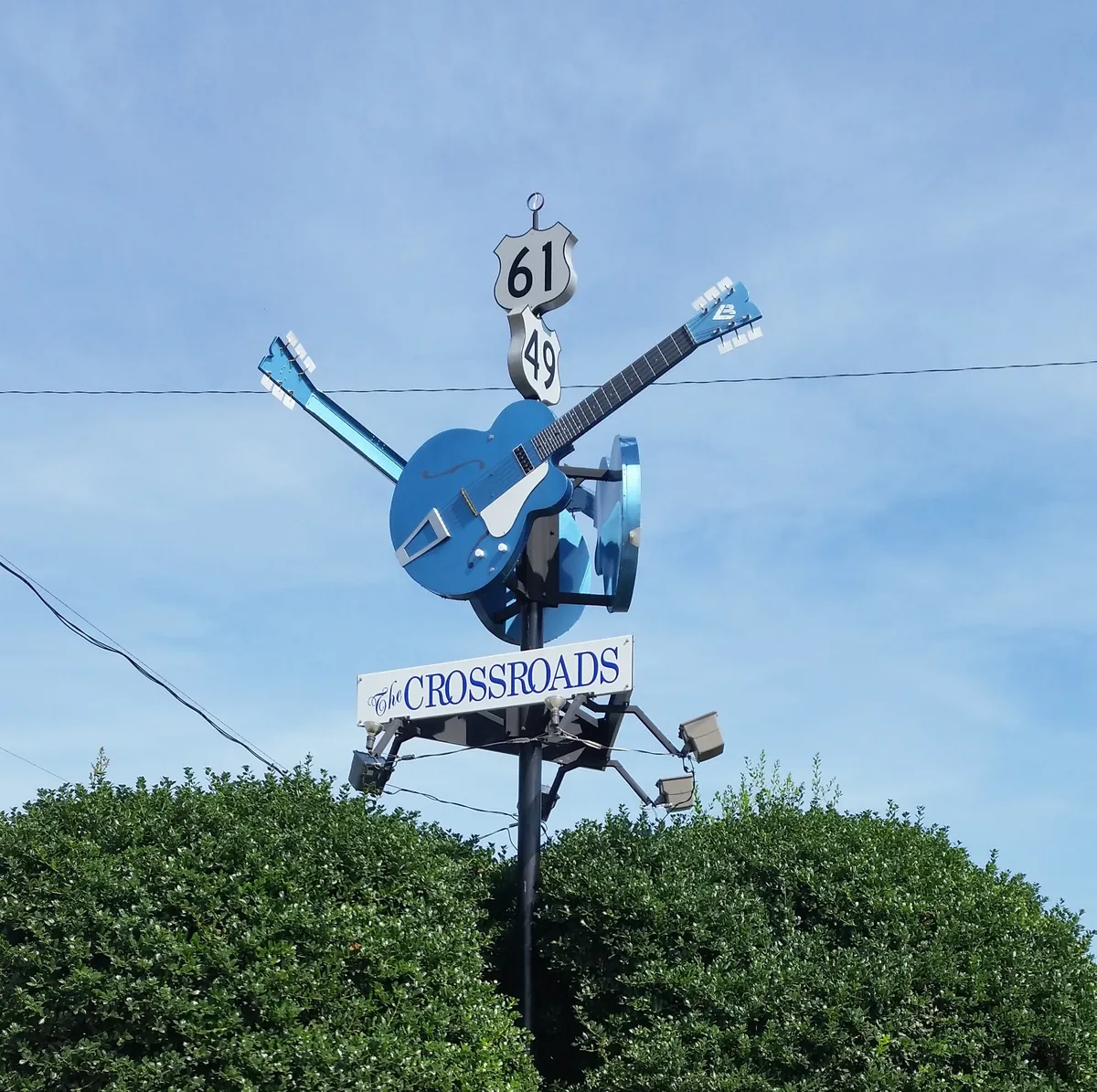
Clarksdale sits in the flat interior of the Mississippi Delta, where the Sunflower River runs through cotton country and three federal highways — U.S. 49, 61, and 278 — converge at the center of town. The land here is alluvial plain, the product of the Mississippi River working the soil for millennia before any settlement arrived. Before European Americans developed the town, the intersection was already a crossroads: the Lower Creek Trade Path, running westward toward present-day New Mexico, crossed the Chakchiuma Trade Trail, which ran northeast toward Pontotoc. Commerce has always moved through this particular point on the map.
John Clark founded the town in 1848, buying land and starting a timber business at a location that quickly became a trading center. Clark married the sister of James Lusk Alcorn, a major planter who would be elected U.S. Senator by the state legislature and later governor by popular vote. Cotton made the town. The county's 1860 census recorded 1,521 whites and 5,085 enslaved people — the arithmetic of the Delta plainly stated. African American slaves cultivated and processed the cotton that earned Clarksdale the title "The Golden Buckle on the Cotton Belt." After the Civil War, those same families remained on the land as sharecroppers and tenant farmers, still at a structural disadvantage, now bound by debt and Jim Crow rather than by law of ownership. The railroad came in 1879; the town incorporated in 1882. The wealth was built. The terms on which it was built are also part of the record.
What the Delta produced in those cotton fields and tenant shacks was something no one planned: an original American music. African American musicians in and around Clarksdale developed the blues — a form that would travel north along the Illinois Central Railroad during the Great Migration and transform popular music worldwide. The Illinois Central ran a major depot in Clarksdale, and by the 1920s, as cotton prices fell and opportunity contracted, it became the primary departure point for those seeking Chicago. The music left with the people. McKinley Morganfield — Muddy Waters — worked the Stovall cotton plantation outside of town, supposedly living there from 1915 until 1943 before leaving for Chicago after mistreatment by a Stovall overseer. John Lee Hooker, Son House, Willie Brown, Ike Turner, and Sam Cooke all came from Clarksdale or passed through it. The town that was built on cotton also built, without quite meaning to, the root system of the blues, rock and roll, and soul.
W.C. Handy lived in Clarksdale for six years. Robert Johnson was a resident during the 1930s — he was inducted posthumously into the Rock and Roll Hall of Fame in 1986. What these musicians made here traveled so far that Jimmy Page and Robert Plant named a 1998 album *Walking Into Clarksdale* as a tribute to the Delta Blues. In 2025, a film set in and around the town during the era these musicians were working drew enough attention that when Clarksdale's cinemas proved unable to screen it — all had ceased operations — the studio arranged free weekend screenings at the Clarksdale Civic Auditorium, with the director present on opening night.
The effort to preserve that legacy began modestly. In 1979, Carnegie Public Library Director Sid Graves started a display series out of the library — and, when the Library Board denied him space, out of the trunk of his car. That collection became the Delta Blues Museum. When Billy Gibbons of ZZ Top discovered it through contact with Howard Stovall Jr., the museum gained national attention. The museum eventually found a permanent home in the renovated Illinois Central Railroad freight depot — the same rail infrastructure that carried the music north now holds its archive. The Sunflower River Blues & Gospel Festival and the Juke Joint Festival grew around it.
Clarksdale has a population of roughly 14,900 and has lost residents steadily for decades, as the mechanization of cotton farming — perfected in part at the nearby Hopson Plantation in 1946, where International Harvester completed a single-row mechanical cotton picker — eliminated the labor economy that once sustained it. The civil rights movement organized here with particular force: Aaron Henry, a local pharmacist, became state NAACP president in 1960 and led a two-year boycott of Clarksdale businesses; Martin Luther King Jr. visited the city twice, in 1958 and 1962. The place has absorbed more than its share of hard history. What it gave the world in return — the blues, and every American music the blues made possible — is not a small thing.