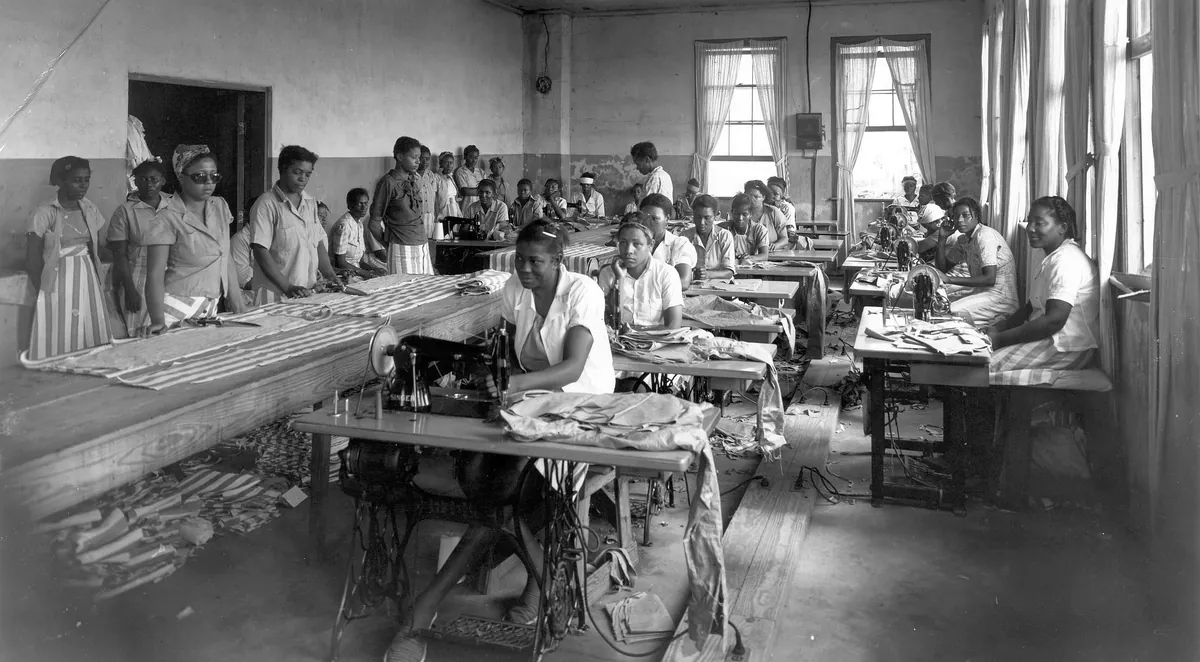
In 1901 the State of Mississippi opened a penal farm on sixteen thousand acres of Sunflower County bottomland. Prisoners cleared forest and broke ground for cotton; the state earned the equivalent of more than $4.6 million in 2009 dollars from Parchman's first year of operations. The Mississippi Department of Archives and History says the institution "was in many ways reminiscent of a gigantic antebellum plantation." Most prisoners were Black men serving long sentences for violent crimes; they worked ten-hour days, six days a week, in ring-around uniforms — horizontal black-and-white stripes. Women worked in the sewing room making clothes, bedding, and mattresses, and when sewing labor was not available, they chopped cotton. An armed trustee system — prisoners deemed reliable were given rifles and made into guards — ran the camps. David Oshinsky wrote that from the outside, early Parchman "looked like a typical Delta plantation, with cattle barns, vegetable gardens, mules dotting the landscape, and cotton rows stretching for miles."
The men sang. Work chants paced the labor — a leader called and the others followed, a tradition traced to West Africa. Alan Lomax visited in 1933 with recording equipment and kept coming back. The 1936 and 1939 sessions with female inmates in the sewing room produced what Samuel Charters called invaluable recordings — a document of how the music sounded at its source. Bukka White was incarcerated in 1937; he recorded 'Parchman Farm Blues' in 1940. In 1959 a gospel song called 'Po Lazarus' was recorded at the prison; it appeared on the *O Brother, Where Art Thou?* soundtrack in 2000. Lomax later wrote: "I had to face that here were the people that everyone else regarded as the dregs of society, dangerous human beings, brutalized and from them came the music which I thought was the finest thing I'd ever hear coming out of my country."
In 1961, 300 Freedom Riders were sent to Parchman after arrests in Jackson. The governor ordered them kept in maximum security, away from other inmates, and told guards to "break their spirit, not their bones." They sang freedom songs — direct descendants of slave spirituals — in their cells. In 1972 a federal judge found that Parchman violated the Constitution and was an affront to modern standards of decency; the trusty system was abolished and the state was required to integrate the facility. The prison is still operating. A Mississippi Blues Trail marker stands at the main entrance on U.S. Route 49W.
- ·Opened 1901 on ~16,000 acres of the Sunflower County Delta
- ·Alan Lomax recorded prisoners 1933, 1936, 1939, and later
- ·Bukka White incarcerated 1937; 'Parchman Farm Blues' 1940
- ·Female-inmate sewing-room recordings 1936/1939 — Samuel Charters called them invaluable
- ·'Po Lazarus' (1959) used on the O Brother, Where Art Thou? soundtrack
Memories
Editorial content compiled with AI assistance. Place details verified against public records.