Northern Arizona
Standing at the edge of the canyon, 7,000 feet up, with the Milky Way overhead and the Navajo Nation on the horizon.
What the brief documents this region is genuinely known for: 1. Ancient Puebloan peoples — Sinagua, Anasazi, Hopi — with ruins at Walnut Canyon, Wupatki, Canyon de Chelly 2. Grand Canyon and the Colorado Plateau's extreme geology 3. The largest ponderosa pine forest in North America 4. Flagstaff as the region's anchor city; the Riordan brothers and the lumber economy that built it 5. Navajo and Hopi nations (48% of the tri-county population) 6. Jerome, Sedona, Prescott as distinct towns shaped by mining and landscape 7. Lowell Observatory; Northern Arizona University 8. Route 66 / Interstate 40 as the connective spine
The brief is thin on specific founding dates for most towns, and thin on Jerome, Sedona, and Prescott specifically. I'll work with what is verifiable.
---
# Northern Arizona
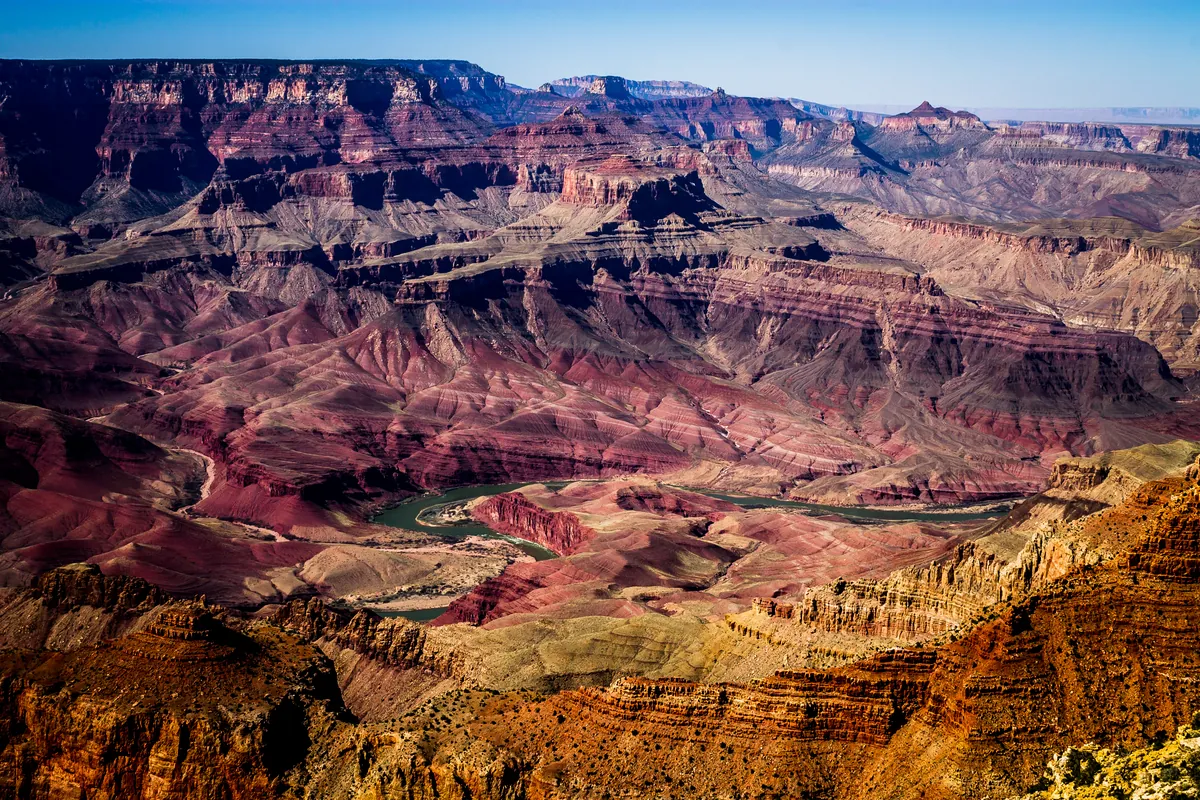
The Colorado Plateau does not ease you into itself. It drops — rim edges giving way to canyon floors a vertical mile below, ponderosa forest giving way to painted desert in the space of a morning's drive. Northern Arizona occupies this plateau and the country below its southern edge, the Mogollon Rim, and the land itself is the first argument: shallow seas once covered all of it, and what they left behind — layered sediment, volcanic fields, a crater from a meteor strike — makes the geology here less a backdrop than a protagonist. The San Francisco Peaks rise as the state's highest ground. The Grand Canyon cuts through the west. The Painted Desert spreads across the northeast. The region does not offer a single landscape. It offers five distinct ones stacked against each other.
People have been reading this terrain for roughly 15,000 years. The Paleo Indians who first moved through it were hunters and gatherers working an arid and unforgiving country. Around 2,000 B.C., corn arrived, and with it the slow accumulation of agricultural society. The Sinagua, the Anasazi, and other Puebloan peoples built communities whose ruins remain at Walnut Canyon, Wupatki, and Canyon de Chelly — evidence of what complex civilization looks like when it is built from and into the rock itself. The Hopi and Navajo nations are the living continuation of that history. Today, Native Americans make up 48 percent of the population across Coconino, Navajo, and Apache counties. The mesa-top Hopi pueblos are, by one measure, the longest continuously inhabited communities in America.
The Anglo economy that arrived in the nineteenth century came for two things: timber and ore. Flagstaff grew as a lumber town, and the Arizona Lumber and Timber Company — run by the Riordan brothers — became its largest employer. The Riordans were not simply extractors. By 1887 they had a doctor on payroll; by 1888 a nurse had opened the first medical facility in town, funded by a dollar-a-month contribution from each employee. They helped establish churches, schools, and the infrastructure a frontier community needed to stop being temporary. Jerome, perched on a steep hillside in the Verde Valley, followed the ore — copper, silver, gold — and had the boom-and-bust arc that mining towns always have. What the brief does not obscure is that these towns were built fast, on other people's land, by workers whose conditions ranged from rough to brutal.
What stayed when the extraction slowed was something harder to account for. Flagstaff anchored Northern Arizona University and the Lowell Observatory — institutions that shifted the town's identity from lumber camp to place of learning and science. The landscape that had been a resource became, for the twentieth century, the destination: the Grand Canyon drawing its millions, the red rock country around Sedona pulling its own. Route 66, and later Interstate 40, stitched the larger cities together along an east-west spine that connected the region to the rest of the country without particularly civilizing it.
Northern Arizona is still the place where the scale of the land exceeds the scale of human ambition. The largest ponderosa pine forest in North America runs through it. Canyon de Chelly holds both ancient ruins and living Navajo communities in the same red-walled space. The ruins at Walnut Canyon and Wupatki are not exhibits — they are structures that have outlasted the civilization that built them by a thousand years. Whatever any individual town became, the region's organizing fact has always been the same: the country here is older and larger than anything people have put on top of it, and it will remain so.