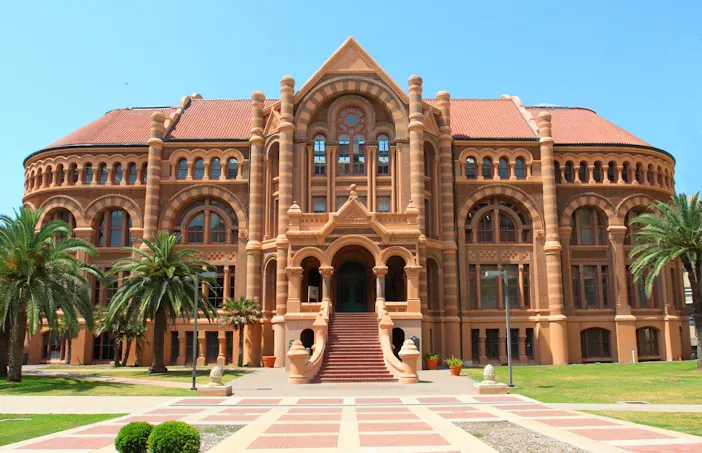
Galveston
A Victorian island that survived the worst storm in American history and decided to stay.
Galveston sits on a barrier island two miles off the Texas Gulf Coast, fifty miles southeast of Houston, at the point where Galveston Bay meets the Gulf of Mexico. The eastern end of the island holds a natural harbor — the best deepwater anchorage between New Orleans and Veracruz — and that geographic accident determined everything that followed. The island is sand and mud, unstable by nature, subject to storm surge from the south and erosion from all sides. The people who built a city here knew this and built anyway.
The first Europeans arrived with piracy as their purpose. Louis-Michel Aury established a base here in 1816 to support Mexico's rebellion against Spain. He returned from a failed raid to find the island taken by Jean Lafitte, who organized it into a pirate colony he called Campeche and governed himself. Lafitte stayed until 1821, when the United States Navy forced him out. Mexico designated Galveston a port of entry in 1825. In 1836, Michel Menard and a group of investors purchased 4,605 acres at the harbor for $50,000 and began platting a city in a gridiron pattern. The lots went on sale in 1838. The Texas legislature chartered the city in 1839. The Republic of Texas briefly made it the national capital. From the start, Galveston was a place people passed through on their way to somewhere else — and then decided to stay.
What they built was astonishing by the standards of a frontier port. The city claimed Texas firsts in the post office, the naval base, a parochial school under the Ursuline Academy in 1847, an insurance company in 1854, an opera house in 1870, a telephone exchange in 1878, and electric lights in 1883. From 1840 to 1870, more than a quarter million European immigrants entered Texas through this port. German families, Jewish merchants, ethnic Mexican residents, and freed Black Texans all made lives here. By 1870 the city's Black population reached 3,000, and leaders like Norris Wright Cuney — who headed the Texas Republican Party and organized a union of Black dockworkers to break the white monopoly on dock labor — made Galveston one of the more functional Reconstruction-era cities in the South. The Strand, the city's commercial spine, was called the Wall Street of the South. By the end of the 19th century, Galveston had 37,000 people and handled more cotton than any port in the world except through competition with New Orleans. In 1891, the University of Texas Medical Branch opened on the island.
On September 8, 1900, a hurricane came ashore without warning and killed between 6,000 and 8,000 people — the deadliest natural disaster in American history. The city did not abandon the island. Engineers designed a seawall ten miles long and seventeen feet high, completed its first section by 1904, and raised 2,200 structures behind it an average of five feet. The city simultaneously invented the commission form of municipal government — the "Galveston Plan" — to administer the recovery. Houston built its ship channel in 1914 and took the port trade. Galveston rebuilt anyway, into something different: a tourist city, a financial city, a medical city. Rabbi Henry Cohen and Congregation B'nai Israel organized the Galveston Movement, which between 1907 and 1914 redirected roughly 10,000 Eastern European Jewish immigrants away from the overcrowded northeastern seaboard and into Texas and the broader West. The Moody and Kempner families founded American National Insurance Company in 1905. William Lewis Moody Jr. and his wife Libbie established the Moody Foundation in 1942.
The Prohibition era gave Galveston a second, stranger identity. Under Sam and Rosario Maceo, the city became the Free State of Galveston — gambling, entertainment, and open vice operating in plain sight, with the Balinese Room as its flagship. That era ended with Texas Rangers raids in 1957. The economy stalled. But the Victorian commercial blocks along the Strand survived intact, in part because there was no money to tear them down, and when preservation became fashionable in the 1960s, developer George P. Mitchell financed the restoration that turned that survival into a historic district. Six such districts now hold over 60 structures on the National Register of Historic Places, including Bishop's Palace — listed by the American Institute of Architects as one of the 100 most significant buildings in the United States. The Grand 1894 Opera House still hosts performances. The Galveston Historical Foundation has operated continuously since 1957.
One more thing happened in Galveston that the rest of the country eventually recognized. On June 19, 1865 — two months after the end of the Civil War and nearly three years after the Emancipation Proclamation — Union General Gordon Granger stood on the balcony of Ashton Villa and read General Order No. 3 to the enslaved people of Texas, informing them they were free. The date is now Juneteenth, a federal holiday. Galveston did not choose to be the place where that announcement was made; the delay was an injustice, not a distinction. What the city did was remember it, and the country eventually agreed that remembering it mattered.