Glenwood Springs
Hot springs, hard rock, and a canyon carved by a river that wouldn't quit.
Glenwood Springs sits at the confluence of the Roaring Fork River and the Colorado River, pressed on all sides by canyon walls that leave almost no flat ground to build on. The terrain is not incidental to the story — it is the story. The narrow valleys forced everything that came here into a single corridor: the Ute people moving seasonally between hunting grounds, then the railroad, then the tourists, all of them following the same geography to the same destination. The hot springs are geothermal, a product of the same restless geology that carved the canyon, and they have drawn people to this spot for thousands of years. Before there was a town, there was the water.
The Ute people — the Kapuuta, Mouache, and Yampa bands among others — used the springs as sacred ground, sources of healing and rejuvenation. An 1868 treaty negotiated by Tabeguache Ute Chief Ouray preserved these hunting grounds. It did not hold. White settlers squatted on the Ute reservation in the early 1880s, and the camp they built — a raw collection of tents, saloons, and brothels — called itself Defiance, a name that said exactly what it meant. Isaac Cooper arrived, platted a legal settlement at the confluence, and persuaded the founders to rename it: his wife Sarah, struggling with the hardship of frontier life, asked that the town be called Glenwood Springs, after her hometown of Glenwood, Iowa. The post office was renamed on March 28, 1884. The town incorporated the following year.
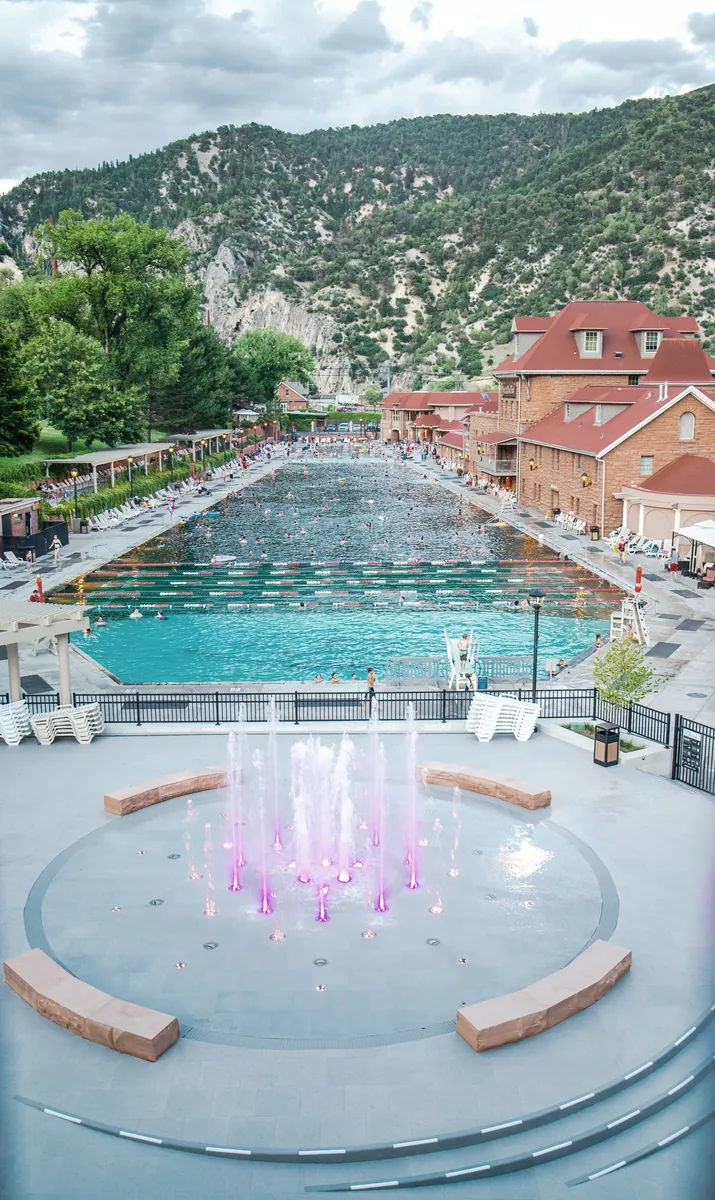
Cooper understood what the springs could become. He joined forces with Walter Devereux, a wealthy mining engineer, and together they set out to build not a mining camp but a resort — the kind that could rival anything in Europe. They hired an Austrian architect to design the bathhouse and the hotel. The bathhouse at Glenwood Hot Springs Pool opened in 1888. The Hotel Colorado welcomed its first guests in 1893. When the Denver & Rio Grande Railroad arrived in 1887 — Cooper, though ill, rode that inaugural train — it delivered the clientele the resort had been designed for. President Theodore Roosevelt used the Hotel Colorado as his base during a three-week hunting trip in 1905, calling it his Western White House. The railroad did not make Glenwood Springs; it confirmed what Cooper had already built.
Doc Holliday arrived in 1887 on the same railroad, hoping the hot springs might cure his tuberculosis. They did not. He practiced dentistry, played cards in the gambling halls, and died in November of that year. He is buried in the Pioneer Cemetery above town, alongside Harvey Logan — Kid Curry — who ran with Butch Cassidy's outfit. The cemetery is not a curated attraction. It is simply where the Wild West put its dead, and Glenwood Springs happened to be where those particular lives ended.
The Shoshone Hydroelectric Generating Station, built on the Colorado River in Glenwood Canyon, began producing power on May 16, 1909 — one of the earliest hydroelectric operations on the upper Colorado. The water rights it established, known as the Shoshone Call, remain among the most significant on the river, more valuable today for protecting Colorado River flows than for the electricity they produce. Glenwood Springs also holds the distinction of being among the first places in the United States to have electric lights, installed in 1897 inside the Fairy Caves on Iron Mountain. The Strawberry Days Festival, founded in 1898, is Colorado's oldest festival and the oldest continuously held civic celebration west of the Mississippi River — still running.
The California Zephyr stops here daily, the second busiest Amtrak station in Colorado after Denver's Union Station. The dome car was invented for the Zephyr family, inspired by Glenwood Canyon itself. The Yampah vapor caves that the Ute people used for healing are still open underground. The water that drew people here before the town had a name still runs at 110 degrees in the rock chambers below the street. Glenwood Springs was built on a vision of what hot water in a mountain canyon could be made into — and most of what was built is still here.