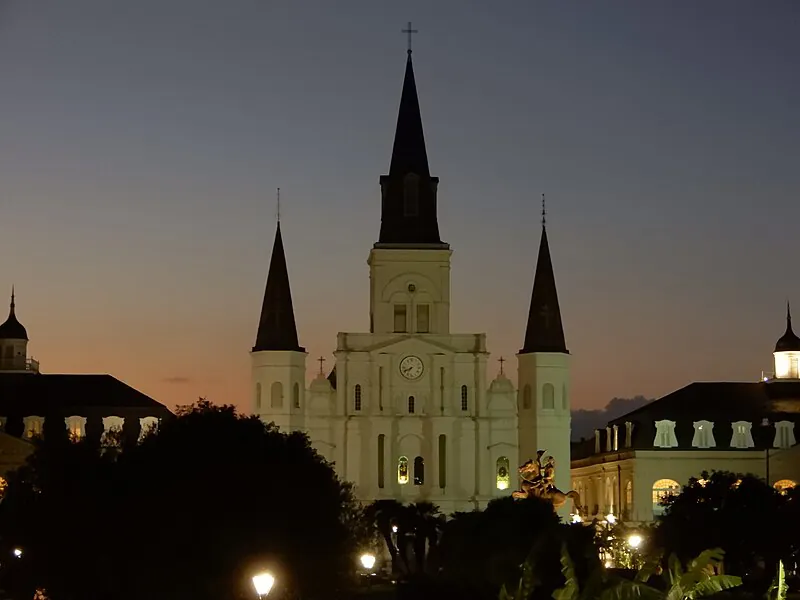
The Choctaw called it *Bulbancha* — land of many tongues — long before Jean-Baptiste Le Moyne de Bienville founded La Nouvelle-Orléans in the spring of 1718 for the French Mississippi Company. The name was apt. The city sits on a crescent of the Mississippi River some 105 miles upriver from the Gulf of Mexico, hemmed by Lake Pontchartrain to the north, marsh and swamp in every direction. Bad ground for a city. Perfect ground for a port. Whoever held this bend controlled the movement of goods between the interior of a continent and the Atlantic world, and every European power in North America understood that. The French got there first.
Bienville laid out a grid on land the Chitimacha had long inhabited, and military engineers Pierre Le Blond de Tour and Adrien de Pauger drew the street plan that still holds. The colony was never easy. The Natchez revolt of 1729 killed more than 200 French colonists and set off the Chickasaw Wars of the following decade. Labor shortages drove the colonists to the Atlantic slave trade; by the early 1720s, enslaved Africans were arriving in significant numbers, and the Code Noir of 1724 formalized the brutal legal architecture governing their lives. Out of that crucible, something the French did not plan emerged: an Afro-Creole culture blending African tradition, Catholicism, and the French language — Louisiana Voodoo, the Louisiana Creole tongue, a sensibility that was neither European nor African but entirely its own. Nuns sponsored by the Company of the Indies established the Ursuline convent in 1727, educating girls in a city where the death rate from yellow fever was already becoming a fact of life.
Spain took the colony in 1763. The residents revolted in 1768, failed, and watched French sovereignty slip away permanently. But Spanish rule left its mark on the built environment: nearly all the surviving 18th-century architecture of the French Quarter dates from the Spanish period, the ironwork balconies and courtyard walls that visitors now take as quintessentially New Orleans. Spain also sent Bernardo de Gálvez, who in 1779 led a campaign against the British from the city, making New Orleans a staging ground for the American Revolutionary cause. Napoleon reclaimed the territory in 1800 and sold it three years later. The Louisiana Purchase of 1803 made the city American in law; in character, it remained something else entirely.
What followed was a century of layered arrivals and collisions. Refugees from the Haitian Revolution poured in between 1791 and 1810 — white Francophones, free people of color, enslaved Africans — doubling the city's population by 1809 and deepening its French-speaking culture and its sugar industry. Irish and German immigrants came through the port. By 1840, New Orleans was the third most populous city in the United States and the wealthiest in the South, its fortune built on the cotton and sugar that moved through its docks and on the largest slave market in the country. It also held, in that same period, the largest and most prosperous community of free persons of color in the nation — educated, propertied, largely Francophone, forming a distinct professional class that would later organize the Comité des Citoyens, recruit Homer Plessy to test Louisiana's Separate Car Act, and force the case that became *Plessy v. Ferguson* before the Supreme Court in 1896. They lost. They had tried.
The city's musical inheritance came from the same collision of cultures. New Orleans was the only city in North America to permit enslaved people to gather publicly and play their native music — largely in Congo Square, now within Louis Armstrong Park. From that permission, and from the blending of European instruments with African rhythms across generations, jazz was born in the early 20th century. What it made was not a regional curiosity. It was the foundational American music. Later came rhythm and blues, funk, bounce, hip hop — each one a product of the same streets, the same layered inheritance, the same city that in the 1960s produced a song by the Dixie Cups that knocked the Beatles off the top of the Billboard Hot 100. Tennessee Williams set *A Streetcar Named Desire* here. The streetcar line to Desire Street became a bus line in 1948.
On August 29, 2005, the federal levee system failed during Hurricane Katrina. More than 80 percent of the city flooded. The death toll, by different counts in the brief, exceeded 1,500 in Louisiana and by some measures 1,800; many remain unaccounted for. It was called the worst civil engineering disaster in American history. The city rebuilt anyway — the Jazz & Heritage Festival never canceled, Mardi Gras never displaced, the music never stopped. That is the New Orleans pattern: absorb the blow, make something from what's left. Three centuries of floods, fever, fire, occupation, and loss have not produced a cautious city. They produced this one.