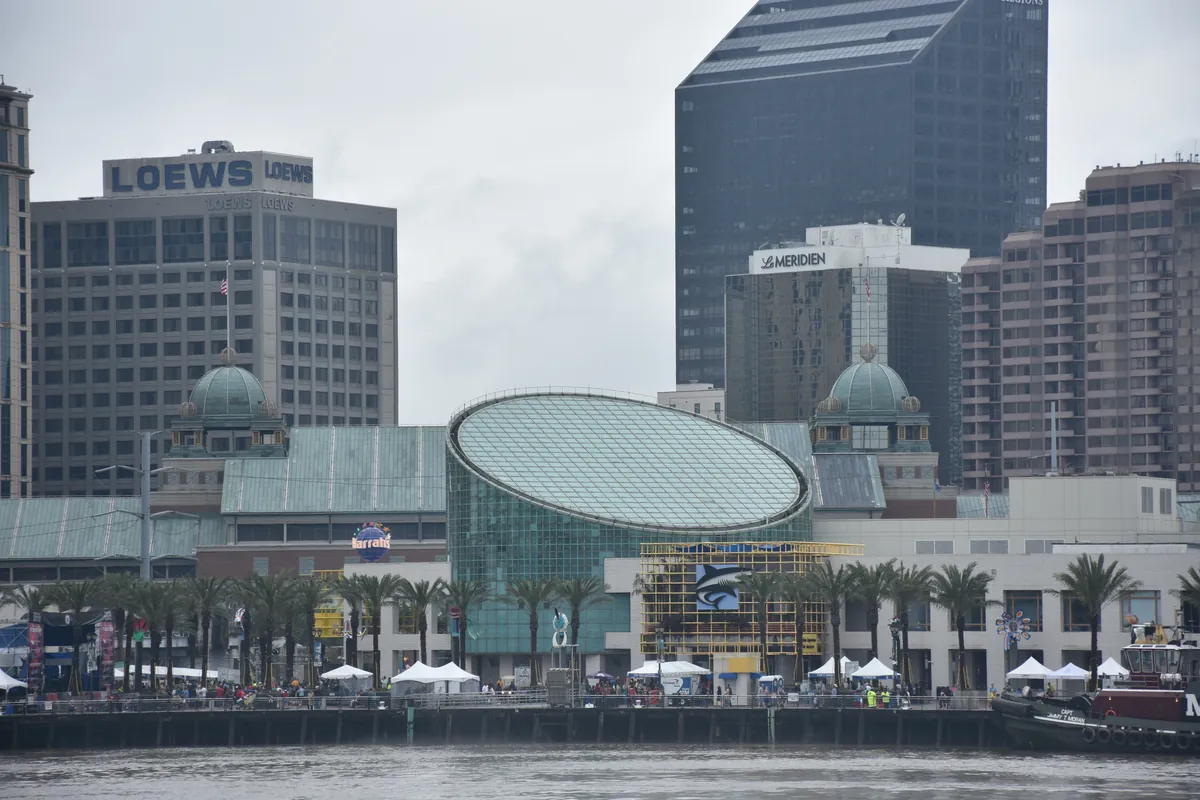
The largest aquatic rescue in American history began at this building after Katrina. The storm had put the Gulf Coast facility on high ground above the flooding that swamped most of the city, but electricity outages continued and backup generators couldn't fully operate the sophisticated life support systems. Staff evacuated, then returned four days later to find most of the 10,000 fish had not survived. The building stood; the power did not.
New Orleans opened the aquarium on September 1, 1990, along the banks of the Mississippi River by the edge of the historic French Quarter, at the upper end of Woldenberg Park. It anchored a billion-dollar waterfront redevelopment. The city had been the largest port in the Southern United States throughout the nineteenth century, exporting most of the nation's cotton output and other farm products to Western Europe and New England. The aquarium made the working riverbank a destination again.
The Gulf of Mexico exhibit is a 400,000-gallon, 17-foot-tall tank holding sharks, sea turtles, and stingrays. The Caribbean reef exhibit features a clear, 30-foot-long tunnel surrounded by a 132,000-gallon tank of tarpon and angelfish. The Amazon exhibit rises in a glass cylinder—a humid, climate-controlled greenhouse prominent on the riverfront, housing macaws, piranhas, an anaconda, and freshwater stingrays. The Mississippi River gallery holds paddlefish, catfish, owls, and a leucistic white alligator.
The aquarium reopened on May 26, 2006. The Audubon Nature Institute runs the facility as part of a conservation network that includes the Audubon Zoo, the Freeport-McMoRan Audubon Species Survival Center, and the Audubon Center for Research of Endangered Species. Following a $41 million renovation that merged the Insectarium into the building, the aquarium reopened with new exhibits on June 8, 2023. It holds 10,000 animals representing 530 species. Open daily. Admission charged.
- ·Built in 1990 as the anchor of a billion-dollar waterfront redevelopment.
- ·The Gulf of Mexico exhibit holds 400,000 gallons with a 30-foot underwater tunnel where sharks swim overhead.
- ·After Katrina flooded the building with eight feet of water, staff evacuated 10,000 animals by boat and truck — the largest aquatic rescue in American history.
- ·Run by the Audubon Nature Institute as part of a conservation network.
- ·Located at the foot of Canal Street. Open daily. Admission charged.
Memories
Editorial content compiled with AI assistance. Place details verified against public records.