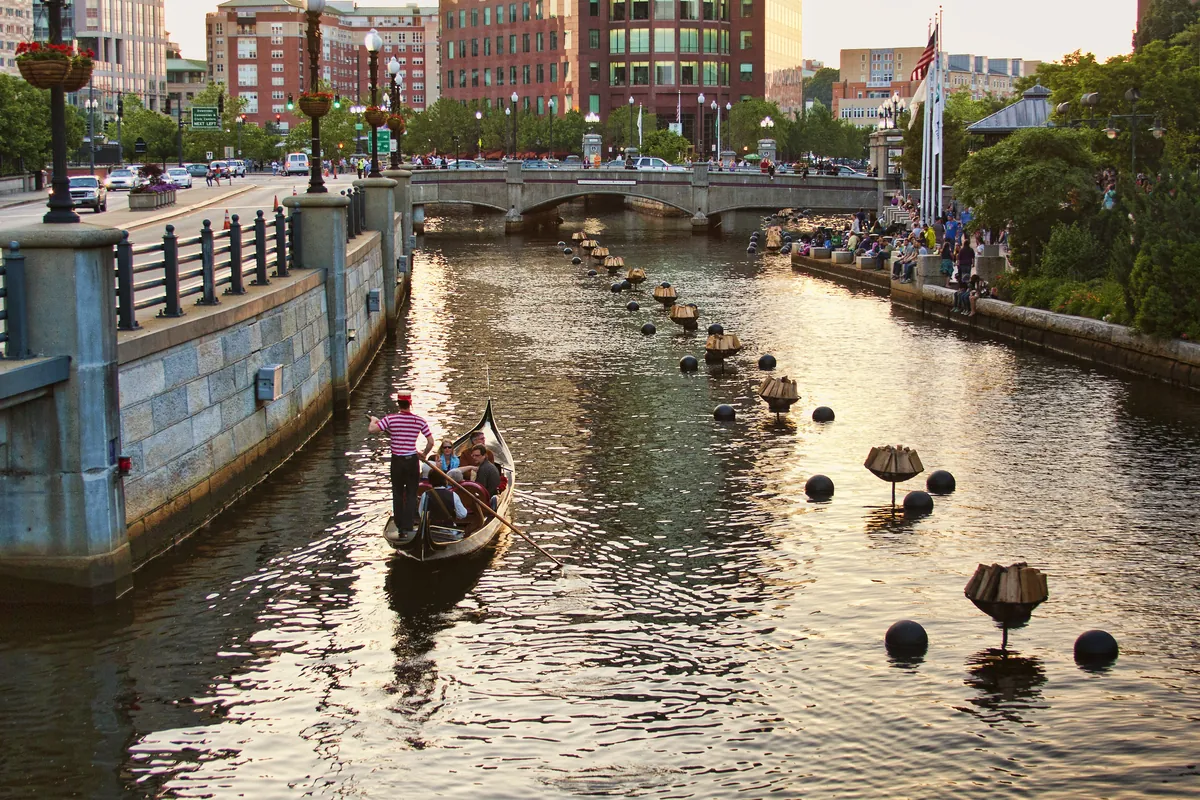
Roger Williams arrived at the confluence of the Moshassuck and Woonasquatucket Rivers in June 1636 not because the land was promising but because he had run out of colonies willing to have him. The Massachusetts Bay Colony had convicted him of sedition and heresy — he had argued for separating church from state and condemned the colonists' seizure of Indian land — and banished him north. He went south instead, down the Seekonk River and around Fox Point, into the shelter of Narragansett Bay. He named the settlement after God's merciful Providence. The position mattered: at the head of the bay, where three rivers met, the place was built to become a port whether its founder intended one or not.
Providence lacked a royal charter from the start, which meant its settlers had to organize themselves. They did — allotting six-acre home lots along what is now South Main Street in 1638, and building the First Baptist Church in America that same year. The colony's relationship to power was always complicated. In 1652, Providence produced the first anti-slavery law in the United States, prohibiting indentured servitude for more than ten years. The Rhode Island General Assembly then legalized African and Native American slavery throughout the colony in 1703, and Providence merchants' participation in the slave trade helped build the port into a commercial force. By 1755, enslaved people made up eight percent of Providence's population. In March 1676, during King Philip's War, the Narragansetts burned the settlement to the ground. Providence rebuilt. In 1772, a group from the city burned a British customs schooner in the Gaspee Affair — the first act of armed resistance to British rule in North America, more than a year before the Boston Tea Party. Rhode Island was the first colony to renounce allegiance to the British Crown, on May 4, 1776.
After the Revolution, Providence shifted from maritime trade to manufacturing and did not stop for a century. The economy moved into machinery, tools, silverware, jewelry, and textiles. By the early 1900s, the city hosted some of the largest manufacturing plants in the country — Brown & Sharpe, the Corliss Steam Engine Company, the Gorham Manufacturing Company, Nicholson File. Waves of immigrants arrived from Ireland, Italy, Portugal, Cape Verde, and French Canada to work them. The jewelry trade grew so dominant that by the 1960s, trade magazines called Providence "the jewelry capital of the world." The Gilded Age left its mark on the skyline: the art deco Industrial National Bank Building still stands at 426 feet, the tallest structure in the city, and the Westminster Arcade — built in 1828 — remains the oldest enclosed shopping mall in the United States.
In 1770, Brown University relocated from nearby Warren to College Hill, choosing Providence over Newport and signaling which city would dominate the colony going forward. That decision compounded over time. The Rhode Island School of Design Museum now holds the twentieth-largest art collection in the United States. The Providence Athenæum — the fourth-oldest library in the country — drew Edgar Allan Poe, who met and courted Sarah Helen Whitman there, and H.P. Lovecraft, who was a regular patron. Trinity Repertory Company, the Tony Award-winning theater, has its home here. Brown University is now the city's second-largest employer.
The twentieth century was hard. The 1938 New England Hurricane flooded downtown and shuttered mills that never reopened. The population fell from a peak of 253,504 in 1940 to 179,213 in 1970. What slowed that fall, inadvertently, was the city's own poverty: Providence couldn't afford to tear down its historic buildings, so they survived. The East Side neighborhood now contains the largest contiguous area of National Register of Historic Places buildings in the United States, including pre-revolutionary houses that outlasted the economy that built them.
Providence was founded by a man the authorities wanted gone, in a place no one else had claimed, under a name that was a prayer. What it made from those circumstances — the oldest Baptist congregation in America, an Ivy League university, a jewelry industry, a manufacturing colossus, a neighborhood of colonial houses intact because there was no money to demolish them — is a city that kept producing things it had no obvious right to produce. That is the Providence pattern.