Puerto Rico
Five centuries of empire, one indestructible island. Old San Juan's walls still stand, the music still plays, the lechón still turns.
Puerto Rico sits at the northeastern edge of the Greater Antilles, the smallest island in that chain, positioned where the Atlantic meets the Caribbean. That location was never incidental. The island sits astride the passage from Europe to Cuba, Mexico, Central America, and the northern coast of South America — a geographic fact that made it, for four centuries, one of the most strategically valuable pieces of land in the Western Hemisphere. The Cordillera Central runs east to west across its interior, pushing rivers north and south, creating microclimates within miles of each other, collecting the rain that feeds the only tropical rainforest in the U.S. Forest Service system. The Puerto Rico Trench — the deepest in the Atlantic — sits seventy miles off the northern coast. This is not gentle geography. It is a place that announces itself.
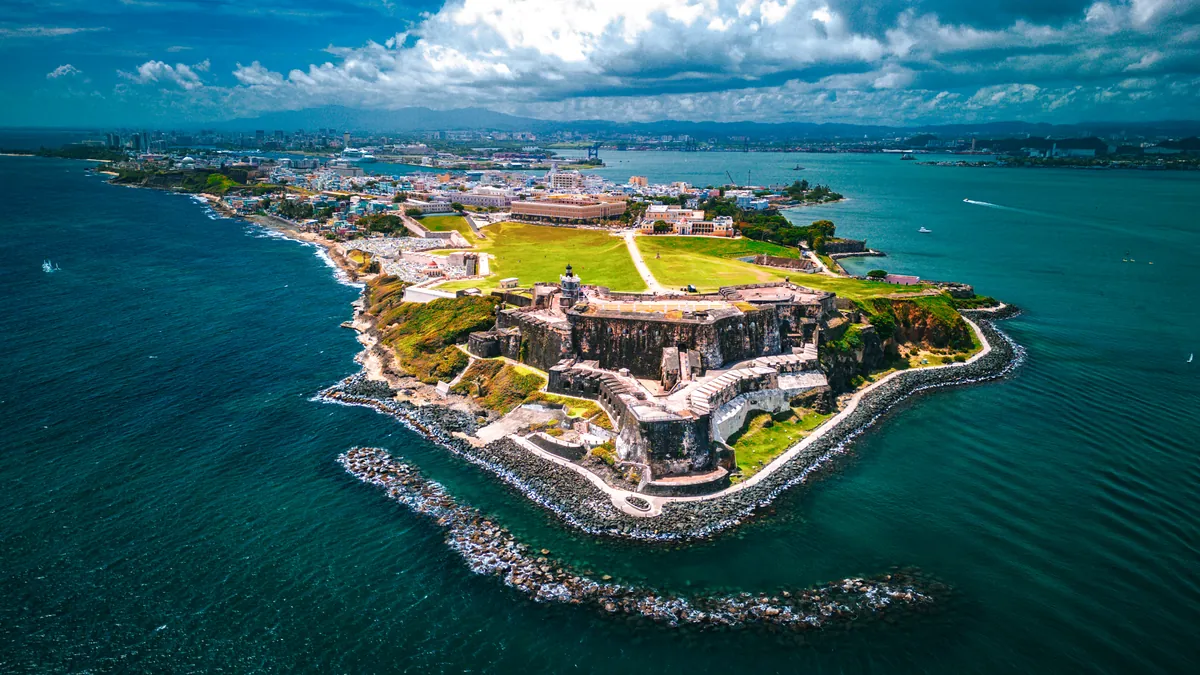
The Taíno called it Boriquen. They had been here since long before Columbus anchored off the western coast on November 19, 1493, and claimed it for Spain. Juan Ponce de León established the first European settlement, Caparra, in 1508 on the island's northern coast. By 1521 Caparra was abandoned for a better site nearby — the new city called Puerto Rico, the port called San Juan — and then the names traded places, as if the island and its capital were still negotiating identity. Spain garrisoned the island heavily: in 1593, Portuguese soldiers sent from Lisbon by Philip II composed the first garrison of the San Felipe del Morro fortress. Fort San Felipe del Morro, Fort San Cristóbal, and La Fortaleza — which still serves as the governor's executive mansion — were built because the island had to be held. England's Francis Drake tried to take it in 1595. He failed. Others tried. None succeeded. Puerto Rico remained Spanish for four hundred years.
That span produced something. The African slaves brought to replace the decimated Taíno population, the Spanish settlers arriving primarily from the Canary Islands and Andalusia, the smaller waves from Corsica, France, Portugal, Ireland, and Germany under the Royal Decree of Graces of 1815 — all of it layered into a culture that was, by the late nineteenth century, recognizably its own. The cuisine built from Taíno staples, Spanish technique, and African tradition. The music — bomba, plena, danza — rooted in Spanish and West African sources, recombined into something that belonged to neither ancestor alone. The Spanish language absorbed Taíno words for plants, weather, and instruments; absorbed West African words for food and dance; became Puerto Rican Spanish. Slavery was abolished in 1873. Autonomy was granted in 1897. One year later, the Spanish-American War transferred the island to the United States.
The U.S. era brought citizenship — collectively conferred by the Jones-Shafroth Act of 1917 — and a constitution ratified in 1952. It also brought Operation Bootstrap, the mid-twentieth-century industrial development push that built a pharmaceutical and manufacturing economy. It brought the Puerto Rican diaspora, the great postwar migration to New York and the northeastern states that produced the Nuyorican literary movement — Miguel Piñero, Piri Thomas, Giannina Braschi writing from the hyphen between two worlds. The 65th Infantry Regiment, the Borinqueneers, fought in Korea and received the Congressional Gold Medal in 2014 for their service. Roberto Clemente played right field for the Pittsburgh Pirates and became something larger than baseball. The coquí — seventeen species of frog, thirteen of them living in El Yunque — became a symbol not because anyone decided it should be, but because it was everywhere and unmistakable, its call the sound of the island at night.
Hurricane Maria in 2017 knocked out all power, blocked 97 percent of roads, damaged 28 percent of health facilities. The debt crisis had already been building for a decade. The population, which peaked at 3.8 million in 2000, has declined by roughly half a million in this century. These are facts. They sit alongside other facts: Old San Juan's colonial walls still stand. The Casals Festival still brings classical musicians to San Juan each year, as it has for decades. La Fortaleza, built to defend a Spanish port, still houses the governor. Ponce Creole architecture — the particular style that emerged in the island's second city between 1895 and 1920, borrowing from France, Spain, and Caribbean vernacular — survived in the houses it was designed for. The culture did not wait for the storms to pass. It kept producing.
Puerto Rico has voted for statehood in multiple referendums and remained a territory. Its political status is unresolved. What is not unresolved is what the island made: a synthesis of Indigenous, African, and European roots that produced its own language, its own food, its own music, its own literature. The place that was held because of its position on a map became worth holding for reasons the mapmakers never planned.