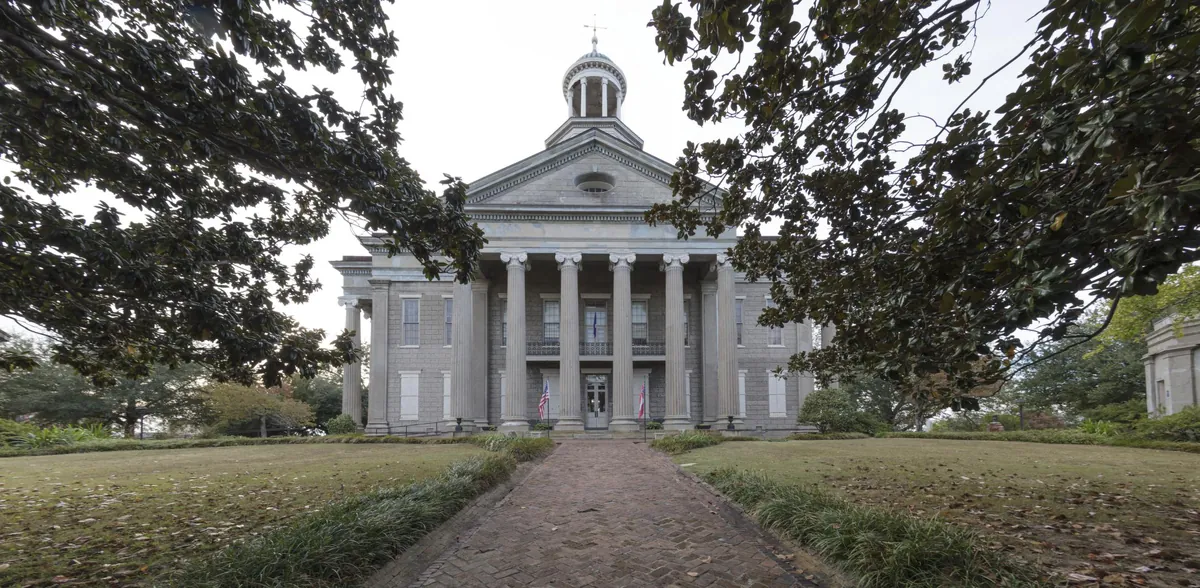
The bluff above the hairpin turn in the Mississippi River was never going to be left alone. Whoever held that high ground commanded the river in both directions — every boat traveling north or south came within range of artillery fire from those heights. The Natchez understood the position's value long before the French arrived. The French built Fort Saint Pierre on the bluffs in 1719, trading furs and establishing plantations. The Spanish came next, founding their own outpost in 1790, which they called Fort Nogales. The Americans took possession in 1798 and renamed it Walnut Hills. By 1825 it was incorporated as Vicksburg, named for Newitt Vick, the Methodist minister who had established a mission on the site. The name changed; the logic of the location never did.
That logic made Vicksburg wealthy. Steamboats worked the Mississippi in the 19th century and Vicksburg sat at the center of the cotton trade, shipping out the harvest of the surrounding Delta counties and drawing merchants from across the mid-South. Among the 3,000 residents at incorporation were roughly twenty Jewish families who had emigrated from Bavaria, Prussia, and Alsace-Lorraine — a fact that suggests the commercial ambition of the early city, the kind of place that pulled people with something to sell or something to build. By 1862, fifty Jewish families had organized the Hebrew Benevolent Congregation Anshe Chesed, chartered by the state of Mississippi.
Abraham Lincoln called Vicksburg "the key." He was looking at a map and seeing what anyone with a military eye could see: the hairpin turn, the bluffs, the batteries that could sink any Union vessel that tried to pass. It took the Union more than a year of campaigning to break the city. Confederate General John C. Pemberton surrendered on July 4, 1863, after a 47-day siege designed to starve the garrison into submission — the bluffs having proved otherwise impregnable to direct assault. The surrender, coming the day after Lee's defeat at Gettysburg, gave the Union control of the entire Mississippi River and split the Confederacy in two. What happened at Vicksburg wasn't a battle; it was the war's hinge.
The city that came out the other side of that siege carried wounds that didn't close quickly. Reconstruction brought political power to Black residents — in 1874 a Black sheriff, Peter Crosby, won election in Warren County — and then violent reversal. Armed white mobs swept through Black areas of the city and the surrounding county in December 1874 in what became known as the Vicksburg massacre, killing somewhere between dozens and hundreds of people; estimates range from 29 at the time to 300 by more recent historians. Federal troops arrived in January 1875, too late to stop the killing, and no one was ever prosecuted. The Red Shirts and their allies drove Black voters from the political system, a disenfranchisement that held for nearly a century. Then, in 1876, the Mississippi River itself shifted course and cut Vicksburg off from its waterfront, taking the port economy with it. The city didn't recover river access until the Army Corps of Engineers diverted the Yazoo into the old channel in 1903.
Two things rose from that era that still define the city. The Vicksburg National Military Park — the preserved ground of the siege itself, including the gunboat USS Cairo raised from the river bottom — became one of the country's most significant Civil War sites. And out of Vicksburg came Willie Dixon, the blues bassist and songwriter who shaped the sound of Chicago blues more than almost anyone else, and Myrlie Evers-Williams, civil rights activist and journalist, whose work outlasted its making. In 1894, local confectioner Joseph Biedenharn bottled Coca-Cola for the first time, in his candy store on Washington Street — a detail that says something about Vicksburg's position on the trade routes of the American South.
The city that exists today is built on what those forces left behind: the military park that draws visitors to walk the siege lines, the floodwall murals painted beginning in 2002 that run the history of Vicksburg from the Natchez to the flood of 1927, and the Army Corps of Engineers installations that now sustain much of the local economy — the institution that once rebuilt the city's waterfront now constituting its largest employer. Vicksburg lost the river, lost the war, lost decades to political terror, and kept building anyway. The evidence is in the stone and the ground.