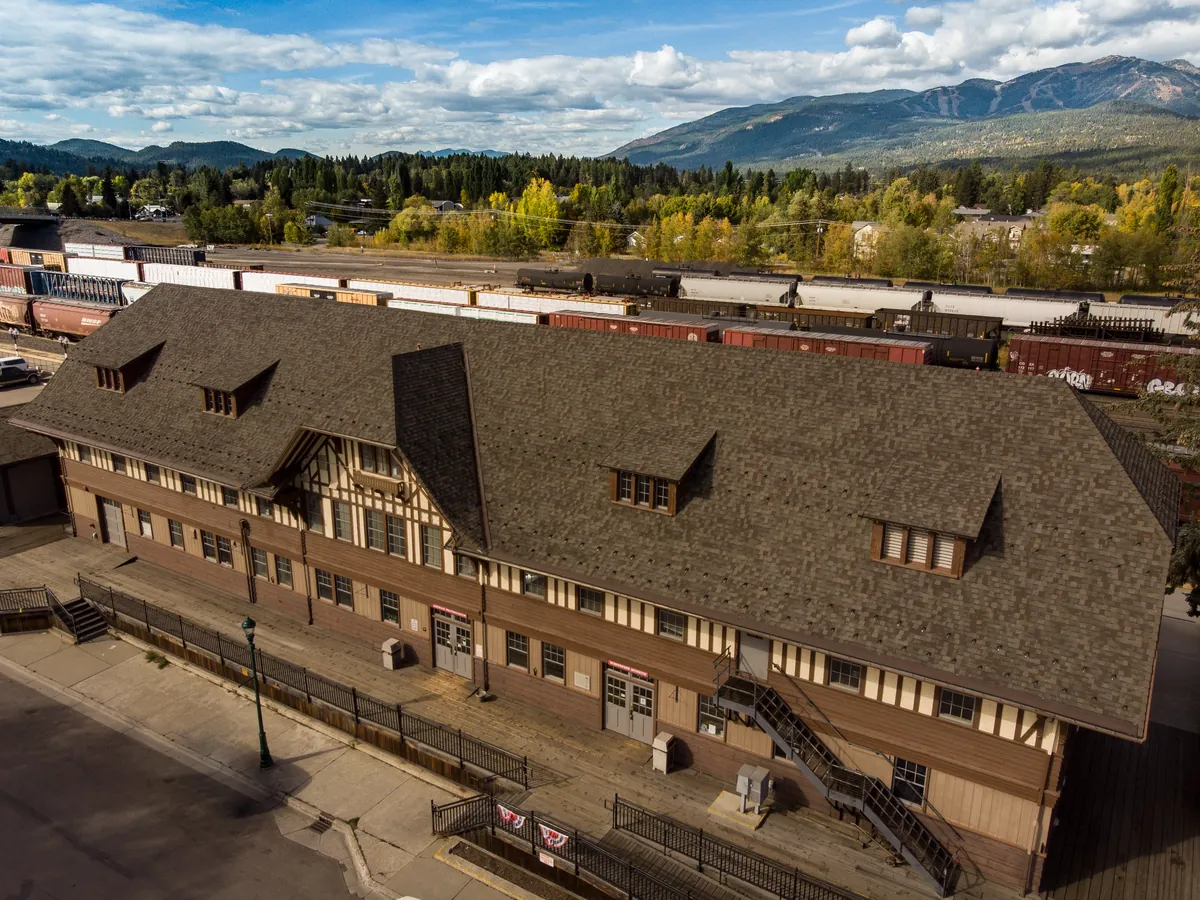
Whitefish sits on the western slope of the Continental Divide, where the Whitefish River cuts south through a valley before joining the Flathead River system and Whitefish Lake — 5.2 square miles of cold water — anchors the town's northern edge. The Kootenai had been in this terrain for more than 14,000 years before any settler drove a stake, hunting the mountains west of the divide and crossing east when the buffalo were worth the journey. What the land offered was timber, water, and a natural corridor. Those three facts determined everything that followed.
The first permanent settler, a man named John Morton, built a cabin on the lake's shore in the early going. Loggers followed — the Baker and Hutchinson brothers among them — in the early 1890s. The Boston & Montana Commercial Company dammed the river mouth so crews could boom their logs and float them south to Kalispell. It was extractive, functional, and it left its mark: the place was called Stumptown, because that is what it looked like when the timber was cleared to build both the railroad and the town. Tree stumps stood in the streets of downtown Whitefish like monuments to the work that made the place.
The decisive turn came in 1904, when the Great Northern Railway rerouted its main line through Whitefish to avoid the steep grade at Haskell Pass. The railroad did not discover Whitefish — it created it. The town incorporated in 1905 and hit 1,000 residents by 1910, crossing the threshold to city status on the strength of railroad workers and the logging industry that fed the line. The historic depot at the center of town is both the origin point and the surviving artifact of that founding logic — now a National Register property, still the busiest Amtrak station in Montana, still moving more than 68,000 passengers a year as of 2006.
The mountain changed everything again after the war. The Whitefish Lake Ski Club had secured a Forest Service permit back in 1937 to build cabins and cut trails in the Hell Roaring Creek area, but the resort on Big Mountain came from a different kind of effort. Great Falls businessmen Ed Schenck and George Prentice saw the potential; the town saw it too and showed up. Local people donated labor, cleared slopes, and gave up free time to push through an all-weather road up the mountain. On December 14, 1947, Schenck, Prentice, and a thousand residents gathered on the new resort's slopes to watch the T-Bar lift run for the first time. A community had built a mountain resort by hand, for itself. That pattern — collective investment in shared terrain — became the identity Whitefish carried forward.
Western author Dorothy M. Johnson was born here, a writer who understood that the West was not a backdrop but a set of forces that shaped the people inside it. The resort she grew up near drew the world to the mountain. The depot that made the town still runs trains. The Whitefish Trail system that rings the city today is protected, in part, by the same community impulse that once cleared those first ski slopes by hand — locals giving what they have to hold what they share.
Stumptown became a city because a railroad needed a gentler grade. It became a destination because its people decided the mountain was worth the work. Both facts are still true.