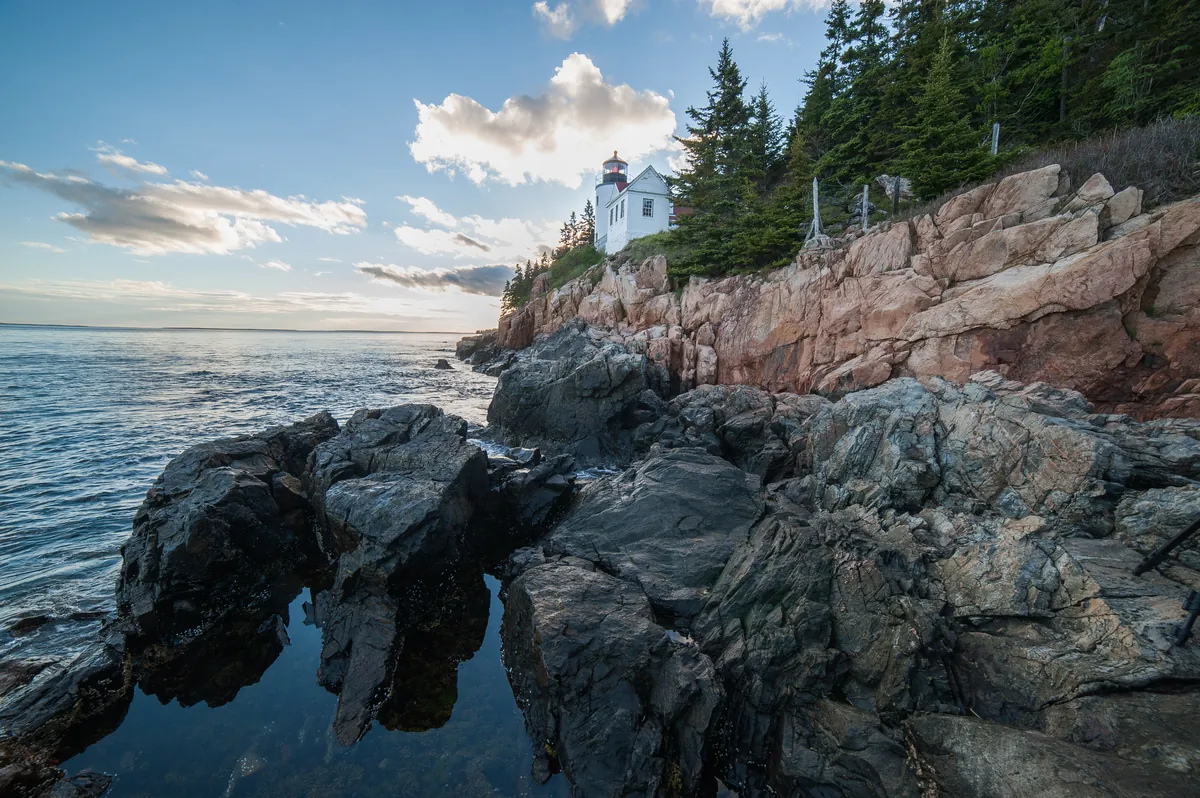
Mount Desert Island sits off the southern coast of Maine, its granite peaks rising bare above the Atlantic — bare enough that Samuel de Champlain, sailing close in September 1604, named it *Isle des Monts Desert*: island of the bare mountains. Somes Sound cuts nearly through its middle, the only naturally occurring fjord on the Atlantic coast of North America. Glaciers carved the rest: the north-to-south gorges, the lakes, the valleys. The island is not subtle. It announces what it is from a distance.
The Wabanaki — the People of the Dawnland, four nations comprising the Penobscot, Passamaquoddy, Maliseet, and Micmac — called the island Pemetic, meaning "range of mountains," and came to its shores to fish, hunt, and dig clams. They called Bar Harbor itself *moneskatik*: the clam digging place. Champlain's 1604 landing, where Chief Asticou's people welcomed him at Somes Sound, was not a discovery. It was a contact. European settlement came later — Abraham Somes established the first permanent European residence at Somesville in 1761, and Israel Higgins and John Thomas settled what is now Bar Harbor in 1763, incorporating the town as Eden in 1796. That original incorporation document was signed by Samuel Adams.
The artists arrived before the resort class did. In the mid-nineteenth century, painters of the Hudson River School — Thomas Cole, Frederic Edwin Church, Fitz Henry Lane among them — came to Mount Desert Island to work. What they were after was light and atmosphere against a landscape that did not look tamed. Their canvases circulated back to the cities, and the cities followed. Steamboats began regular service, and by 1855 most development was concentrating on Bar Harbor's northeastern shore. After the Civil War, the building boom accelerated: David Rodick's Rodick House, built in 1875, eventually grew to 400 rooms and could accommodate a thousand guests. By 1880, thirty hotels were operating in Bar Harbor. The place the Wabanaki had come to dig clams had become one of the premier summer addresses on the eastern seaboard.
What the Gilded Age built here was extravagant. La Rochelle, constructed in 1903, was a 13,000-square-foot mansion on two acres with twenty bedrooms and ten full bathrooms — and it was considered a cottage. The Bar Harbor Historical Society operates the property today. But the forces that shaped the island's permanent character came not from the wealthy alone. In 1947, a fire burned through more than 15,000 acres of Acadia National Park, taking summer homes, hotels, and forest with it, burning for approximately a month. The cause was never determined.
The park itself exists because of a specific act of will. John D. Rockefeller Jr. and other wealthy landowners donated the land that became Acadia National Park, finalized in 1929. Rockefeller then built 45 miles of motor vehicle-free carriage roads through the park, along with 16 stone-faced bridges, each unique in design — the work of a man who wanted people to move through the landscape at a pace where they could actually see it. Cadillac Mountain, whose name traces to the French land grant to Antoine de la Mothe, Sieur de Cadillac in 1688, stands as the highest point on the North Atlantic seaboard and the first place in the United States to see the sunrise in fall and winter.
The Abbe Museum, the first and only Smithsonian Affiliate in the state of Maine, carries the Wabanaki story forward — 12,000 years of presence on these lands, rendered in permanent and rotating exhibits, and celebrated each year at the museum's Indian Market. The island the Gilded Age treated as a playground was inhabited long before the summer people came, and the Wabanaki nations are still here. Bar Harbor holds all of it at once: the carriage roads Rockefeller built so no car could intrude, the working lobster pounds on the quiet side of the island, the granite peaks that Champlain named because they looked like nothing he could make safe.