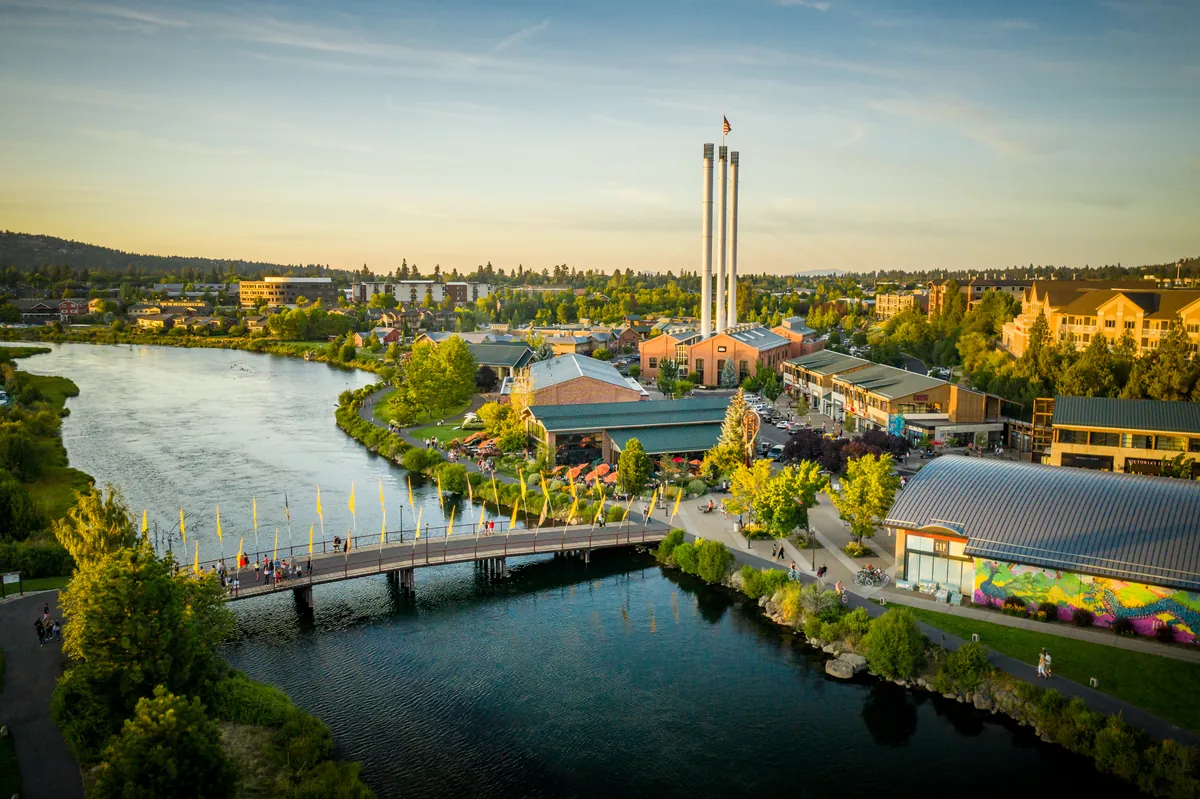
Bend sits on the east side of the Cascades at 3,623 feet, where the high desert begins and the ponderosa pine gives way to sagebrush. The Deschutes River cuts through it, running through a double bend that gave the place its name — pioneers forded here because they could, and the crossing mattered. The Cascades to the west catch the Pacific moisture and leave Central Oregon dry: the city receives about 10.6 inches of precipitation annually, considerably more than true desert but enough sun to make the distinction academic to anyone arriving from the wet side of the mountains. What the geography produces is a place of extremes — volcanic geology underfoot, an extinct cinder cone inside the city limits, the river threading through it all.
The first Euro-Americans settled the area in the 1870s. John Young Todd, a Missourian who had served in the Mexican War, purchased a land claim and named it Farewell Bend Ranch. The ranch changed hands, a post office was applied for, and by 1886 the name had been shortened to Bend because Farewell Bend was already spoken for elsewhere. The first commercial sawmill arrived in 1901, built by the Pilot Butte Development Company. A second followed in 1903. By 1904, the community's 300 residents voted to incorporate, and on January 4, 1905, the city held its first official meeting with A. H. Goodwillie as its first mayor. In 1910, the Bend Water, Light & Power Company dammed the Deschutes to create Mirror Pond and gave the city its first electricity.
For half a century, timber was the economy. Then in 1950, the Shevlin-Hixon Lumber Company closed — absorbed by Brooks-Scanlon after the timber ran out — and Bend took the largest economic hit the region had seen since the Great Depression. What that collapse produced, unintentionally, was a city that had to become something else. It did. The mountains and the river and the high-desert light were always there. The question was whether anyone would come for them. They came.
What Bend built in the decades after the mills went quiet is a serious outdoor infrastructure: POWDR Corp. acquired Mt. Bachelor for ski recreation in 2001, anchoring winter tourism from Oregon, Washington, and California. The trail network grew to over 300 miles of mountain bike routes. The Deschutes River drew rafters, fly fishers, kayakers. And then the breweries — Deschutes Brewery became the eighth-largest craft brewery in the nation, and the city eventually counted over 30 breweries within its limits, a concentration remarkable enough to generate its own touring culture along the Bend Ale Trail.
The notable figures the city produced tend to reflect its particular mix of ambition and landscape. George P. Putnam — publisher, mayor during 1912–13, husband of Amelia Earhart — ran the city during its formative years. Donald M. Kerr founded the High Desert Museum. Les Schwab built his tire center empire here. Olympian decathlete Ashton Eaton trained in this terrain. These are not the names of a place that settled for what it was handed.
Bend lost its timber economy and rebuilt around what the land actually offered. The volcanics are still underfoot — Pilot Butte rises inside the city limits, and Newberry National Volcanic Monument sits just to the south. The river still runs through Mirror Pond. The mountains that blocked the rain also blocked the crowds, until they didn't. The city that formed at a useful river crossing is now a destination in its own right, shaped less by what was extracted than by what was left when the extraction ended.