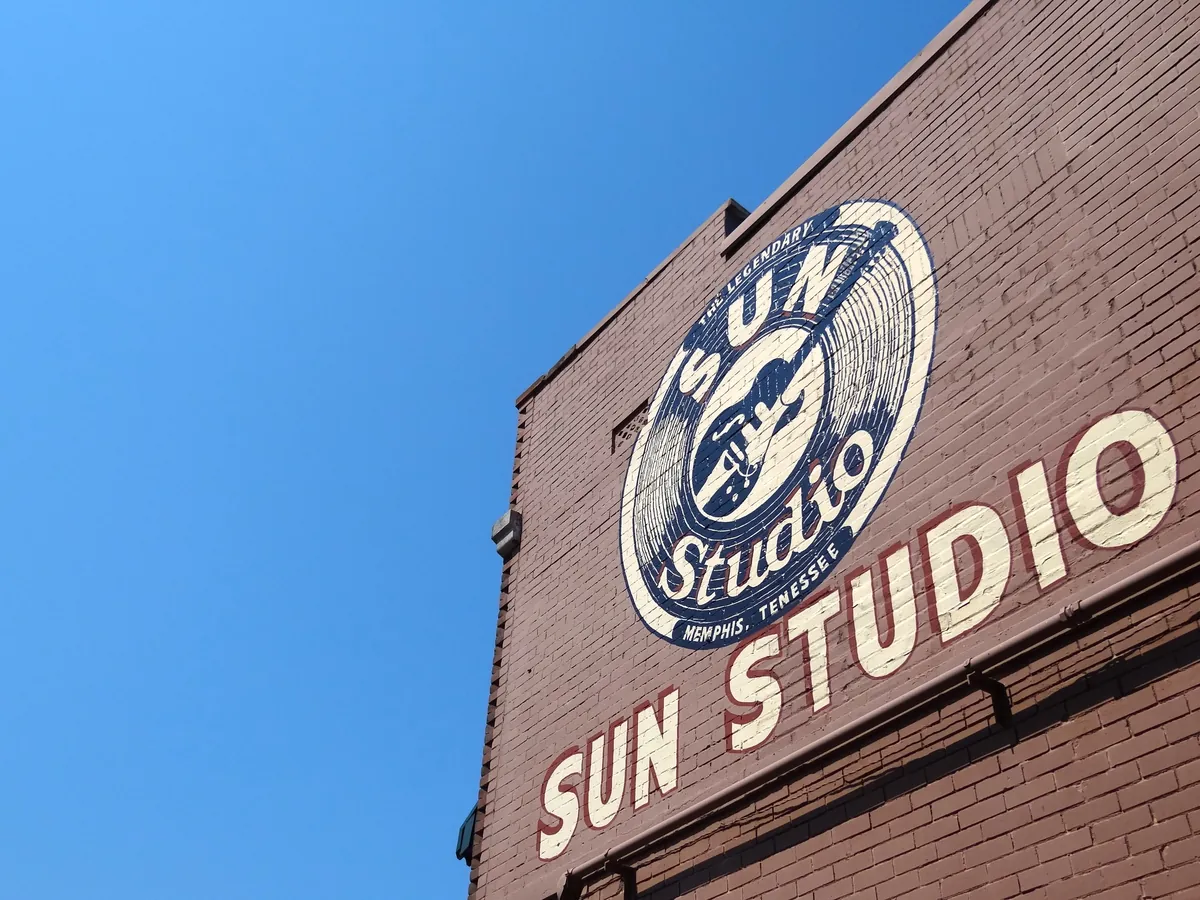
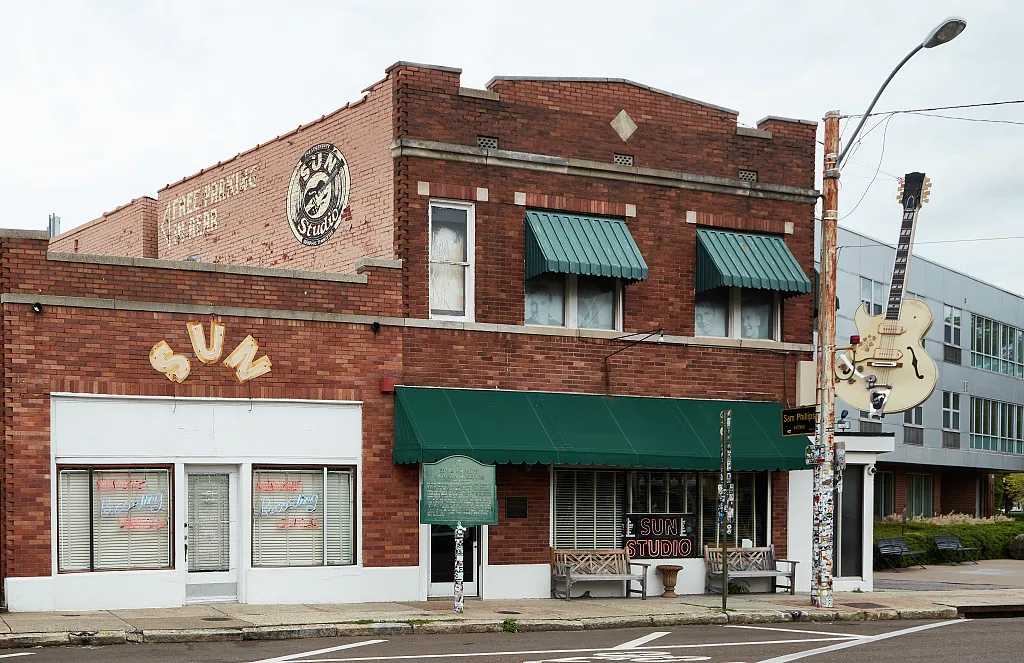
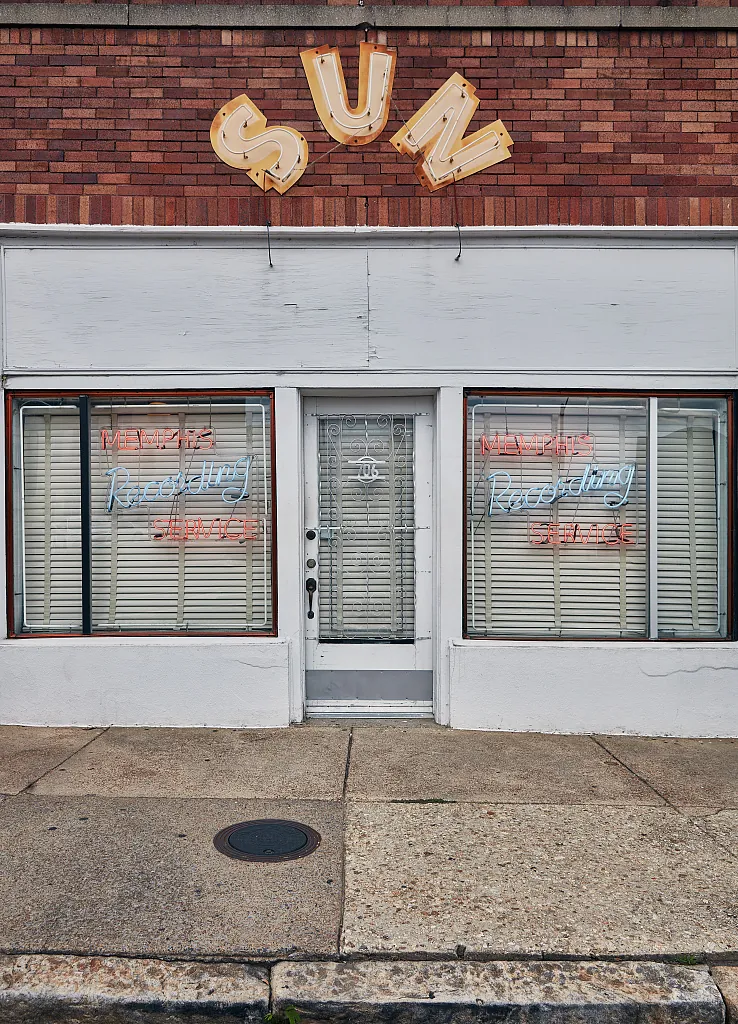
Sam Phillips opened Memphis Recording Service at 706 Union Avenue on January 3, 1950. He was a WREC radio engineer; his assistant was Marion Keisker. To make money at first, Phillips recorded conventions, weddings, choirs, funerals — anybody who walked in and could pay. His slogan was "We Record Anything, Anywhere, Anytime."
In 1951, Phillips recorded Jackie Brenston and his Delta Cats — Ike Turner on keyboards — doing "Rocket 88." The song is often called the first rock and roll single. The amplifier was broken; the tour guides say it was stuffed with newspaper, which gave the track its fuzzy sound. Phillips launched Sun Records in early 1952. He recorded B.B. King, Howlin' Wolf, Rufus Thomas, Junior Parker, Little Milton, James Cotton, Rosco Gordon — the first Delta blues records cut in Memphis.
In August 1953, an eighteen-year-old named Elvis Presley walked in to cut a two-sided acetate: "My Happiness" and "That's When Your Heartaches Begin." He told Keisker he sang all kinds; when she asked who he sounded like, he said, "I don't sound like nobody." She wrote on the ledger: "Good ballad singer. Hold."
Phillips had said, over and over, "If I could find a white man who had the Negro sound and the Negro feel, I could make a billion dollars." In June 1954, he called Presley back and asked two local musicians — guitarist Scotty Moore and bassist Bill Black — to work something up for a session. On the evening of July 5, 1954, the session was going nowhere. Late at night, Presley picked up his guitar and started singing Arthur Crudup's "That's All Right," fooling around. Moore and Black joined in. Phillips stuck his head out of the control booth and said, "What are you doing?" They said, "We don't know." He said, "Well, back up, try to find a place to start, and do it again." Phillips rolled tape. Three days later, Memphis DJ Dewey Phillips played "That's All Right" on his show; listeners called in to find out who the singer was. The phone kept ringing. Dewey played it for two hours straight.
By late 1955, Phillips knew Sun wasn't big enough to break Presley nationally. He sold Presley's contract to RCA Victor for thirty-five thousand dollars — an unheard-of sum for a recording artist who hadn't yet proven himself on the national stage. Phillips used the money to advance Johnny Cash, Carl Perkins, Jerry Lee Lewis, Roy Orbison.
On December 4, 1956, Perkins came in to record; Jerry Lee Lewis was on piano. Presley dropped in to pay a casual visit, accompanied by his girlfriend, Marilyn Evans. After listening to playback in the control room, Presley went into the studio. A jam session started. At some point Johnny Cash arrived. Engineer Jack Clement thought, "I'd be remiss not to record this," and ran tape. Phillips called the Memphis Press-Scimitar; a reporter and photographer came over. The next day, the paper ran a story under the headline "Million Dollar Quartet," with a photograph of Presley at the piano, Lewis, Perkins, and Cash around him. The photo proves Cash was there; the audio tape doesn't confirm he sang.
By the mid-1960s, Phillips had lost interest in recording and opened radio stations instead. Sun released its last record in 1968. In 1969, Shelby Singleton bought the label; the building was sold to a plumbing company, then an auto parts store. The studio was used for inventory storage.
In 1987, Gary Hardy reopened 706 Union Avenue as Sun Studio — a working studio and tourist attraction. U2, Def Leppard, John Mellencamp, Chris Isaak recorded there. It still records. Memphis was the world's largest spot cotton market and the world's largest hardwood lumber market; it was also where the Delta blues came north and met a white kid who didn't sound like nobody. You can still stand in the room where that happened.
- ·706 Union Avenue, Memphis; opened January 3, 1950 by Sam Phillips
- ·Originally Memphis Recording Service; Sun Records label founded 1952
- ·'Rocket 88' (1951, Jackie Brenston / Ike Turner) — often called the first rock and roll single
- ·Elvis Presley first session here July 5, 1954
- ·Reopened as working studio 1987 after dormancy
More archive
Memories
Editorial content compiled with AI assistance. Place details verified against public records.