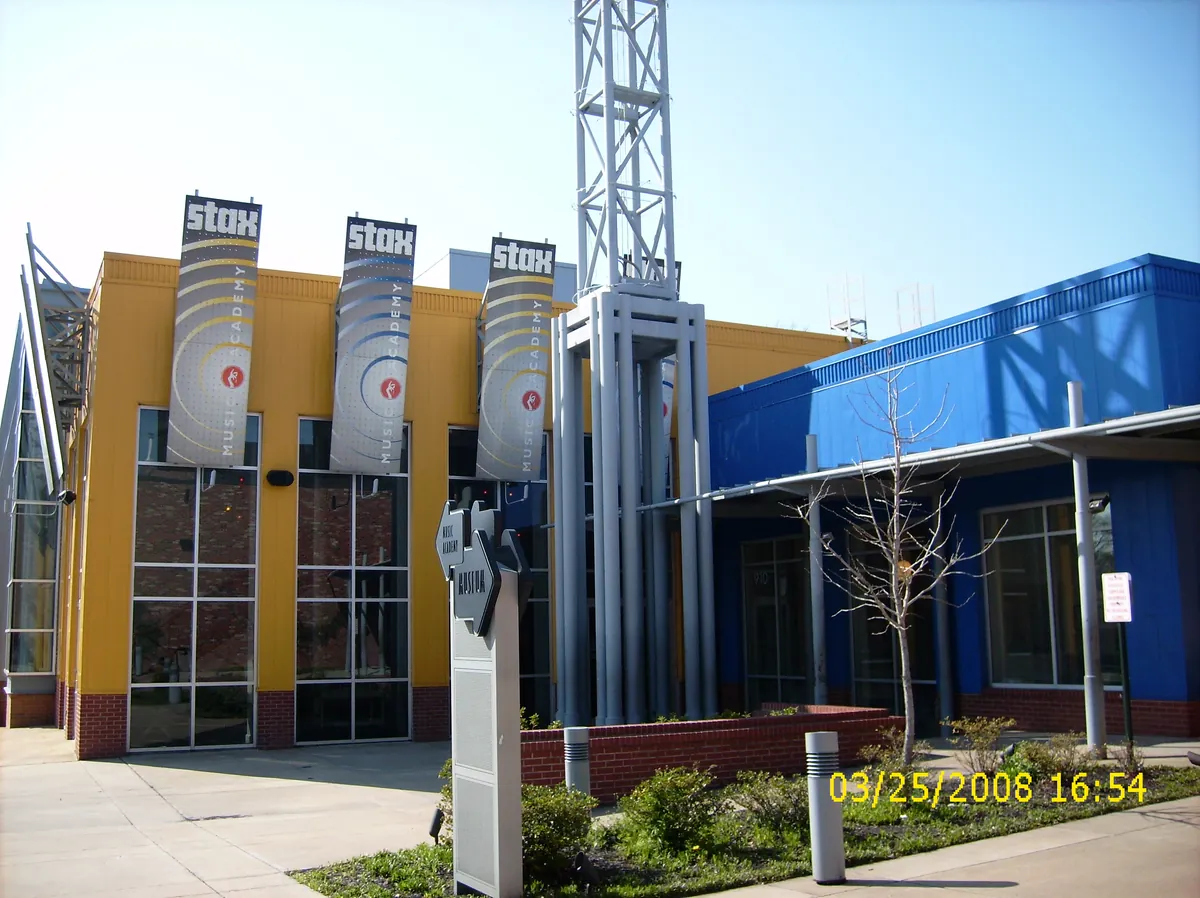
Jim Stewart and his sister Estelle Axton started Satellite Records in Memphis in 1957. They renamed it Stax — Stewart plus Axton — in September 1961. A year earlier, in 1960, they'd moved into the former Capitol Theater at 926 East McLemore Avenue. They built a recording room over the old theater's sloped floor. The slope stayed. That tilt gave Stax records the deep, slightly off-center sound that defined Southern soul.
What came out of that room: Otis Redding, Booker T. & the M.G.'s, Sam & Dave, the Staple Singers, Isaac Hayes, Wilson Pickett, Albert King, Rufus Thomas, Carla Thomas. On December 10, 1967, Redding's plane went down, killing him and four Bar-Kays. Stax was forced into bankruptcy and closed in 1976. The Union Planters Bank sold the building to Southside Church of God in Christ for ten dollars. The church never used it. The building was demolished in 1989.
By 1998, the neighborhood had collapsed. Former Stax artists, Memphis business people, and anonymous donors launched a nonprofit effort to revive it. Construction on the Stax Museum and the adjacent Stax Music Academy began in April 2001. The museum opened in 2003 on the original site — same address, same slope rebuilt in Studio A. It's a 17,000-square-foot replica holding more than 3,000 items: Isaac Hayes' gold-trimmed peacock-blue 1972 Cadillac Eldorado, Jim Stewart's original violin, Skip Pitts' wah-wah pedal from "Theme From Shaft," a circa-1906 Mississippi Delta church reconstructed inside to show gospel's root in soul, the Soul Train dance floor, Hayes' 1972 Academy Award for Best Musical Score.
The Stax Museum is one of a handful of museums in the world dedicated to soul music. It celebrates Stax artists and covers Motown, Hi Records, Atlantic, Muscle Shoals — footage of Aretha Franklin, Al Green, James Brown, Marvin Gaye. TIME called it the most authentic American experience in Tennessee. It won the 2015 Tennessee Governor's Arts Award. In February 2022, it was added to the United States Civil Rights Trail.
The Soulsville Foundation runs the museum, the Stax Music Academy next door, and The Soulsville Charter School. Since 2008, every senior enrolled in the Music Academy has been accepted to college. Since 2021, every senior has received a music scholarship. The Charter School has sent every senior to college or post-secondary education since its first graduating class in 2012. Justin Timberlake installed a permanent songwriting lab there in 2019.
Memphis built its economy on cotton and hardwood in the early 20th century — the world's largest spot cotton market, the world's largest hardwood lumber market. The wealth was built on plantations worked by enslaved people. Yellow fever killed more than 5,000 residents in 1878 and forced the city into bankruptcy. By the 1960s, Memphis was a center of civil rights struggle. Dr. Martin Luther King Jr. came to support striking sanitation workers in 1968. He was assassinated at the Lorraine Motel on April 4. The museum stands in Soulsville, a historically Black neighborhood where the sound that came out wasn't protest music — it was the sound of what people built when they had a sloped floor, a few microphones, and something to say. Go to hear what survived.
- ·Founded 1957 as Satellite Records by siblings Jim Stewart and Estelle Axton
- ·Renamed Stax (Stewart + Axton) in September 1961
- ·Located at 926 East McLemore Ave, former Capitol Theater, from 1960
- ·Otis Redding plane crash December 10, 1967 — killed Redding and 4 Bar-Kays
- ·Original building demolished 1989; Museum opened on original site 2003
Memories
Editorial content compiled with AI assistance. Place details verified against public records.