The Door Peninsula reaches fifty miles into Lake Michigan like a finger pointed at Michigan's Upper Peninsula — water on both sides, cold and deep, with Green Bay to the west and open lake to the east. At its tip, a narrow strait separates the land from Washington Island. French explorers heard Native American accounts of a disastrous Ho-Chunk raid across that passage in the early 1600s, and the name stuck: *Porte des Morts*, Death's Door. Emmanuel Crespel put it on paper in 1728, calling the peninsula *Cap a la Mort*. The county took that name and wore it without apology.
The land came formally into American hands after the 1831 Treaty of Washington. Federal surveyors arrived to inventory the timber; what followed was the pattern of the American frontier — loggers, fishermen, squatters. By the time the Homestead Act passed in 1862, most of the peninsula's nearly 2,000 farmers were already working land they didn't legally own, pulling their income from lumber and wood products. A thousand more residents made their living from fishing. The county had been formally separated from Brown County in 1851, organized in 1861, and it was filling in fast.
What filled it was not a single wave but several. In 1853, Moravians founded Ephraim after a land dispute broke apart their colony near Green Bay — Nils Otto Tank had resisted attempts at reform, and the congregation moved north to start fresh. In the southern part of the county, Belgian Walloons arrived in significant numbers, built small roadside votive chapels, and brought the Kermiss harvest festival with them; a small pocket of Walloon speakers formed what remains the only such community outside Wallonia and its nearest neighbors. From Pomerania in eastern Prussia came German settlers in the 1860s, drawn by letters home describing land that could be owned outright — a concept impossible under the junker landlord system they'd left. Norwegians, Swedes, and other Scandinavians settled the northern reaches of the peninsula. The county was organized by the 1870s into distinct ethnic settlements that kept their churches and their languages and gradually became neighbors.
The 1871 Peshtigo fire reached the county, killing 128 people, including 59 in Williamsonville alone. That ground is now Tornado Memorial County Park, named for the fire whirl that moved through it. The peninsula kept going. The Sturgeon Bay Shipping Canal was completed in 1881, cutting the northern half of the peninsula into what became, technically, an artificial island. A Coast Guard station was established at Sturgeon Bay by 1885 or 1886. By 1894, rail service had extended to Sturgeon Bay, though many tourists still took the train to Menominee, Michigan and crossed Green Bay by steamship, because the peninsula roads north of Sturgeon Bay were simply too poor for coaches until crushed stone highways arrived in the early 1920s.
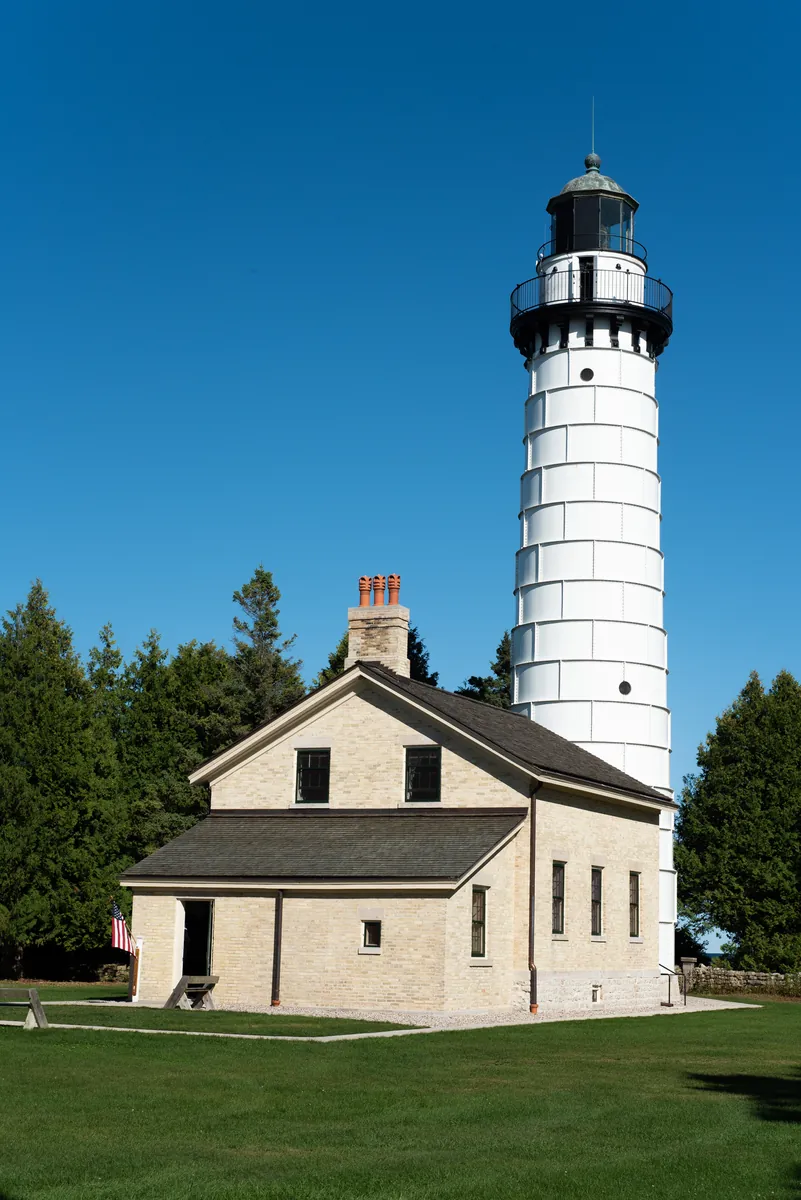
By 1909, at least 1,000 tourists were making the trip each year. By 1920, that number had grown to 125,000; by 1969, one million. What they came for was already built: 298 miles of shoreline, six state parks, 50 lighthouses and lights along both coasts — most of them constructed in the 19th century, most of them still serving as navigational aids, and several listed on the National Register of Historic Places. The Ridges Sanctuary in Baileys Harbor preserves an orchid collection. In Ephraim, the Village Hall, the Lutheran and Moravian churches, and the Peter Peterson House all carry National Register designation. The fish boil, the cherry orchards, the stave churches, the rune-inscribed furniture in Rock Island State Park's structures — these are not attractions assembled for visitors. They are what the peninsula's settlers made and left behind.
The county is Wisconsin's largest by total area — 80 percent of it water. Of 214 known confirmed and unconfirmed shipwrecks in these waters, some are now dive sites. The passage that killed enough people to earn a name from the French is still the way in. The rest of Door County is what the people who survived it built.