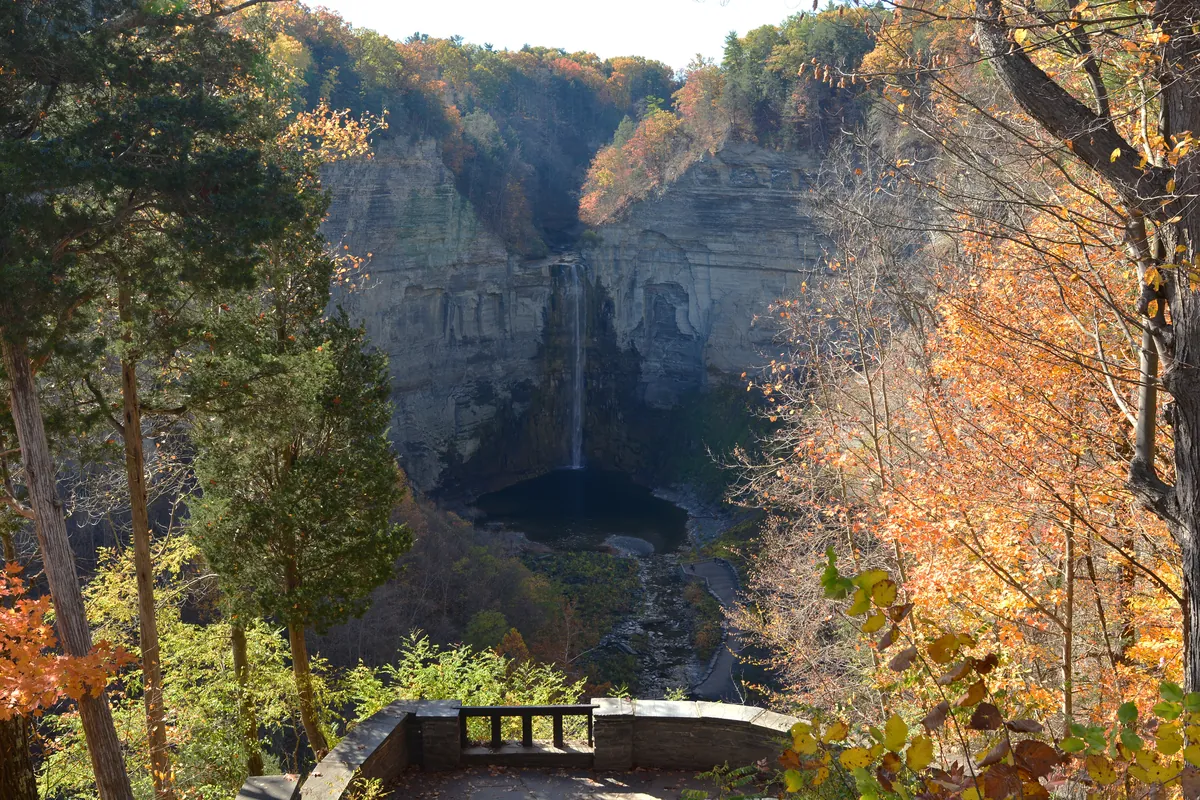
The eleven lakes didn't arrive on a map — they were carved. Two million years of continental glaciation sent the Laurentide Ice Sheet southward from the Hudson Bay area, again and again, grinding existing river valleys into deep, narrow trenches running north to south across the Northern Allegheny Plateau. When the ice retreated, glacial debris dammed the valleys and the water filled in. The result: eleven long, narrow lakes, some of them deeper than the ocean floor is above sea level. Seneca reaches 618 feet down. Cayuga goes to 435. Their bottoms sit below sea level. The lakes don't just sit in the landscape — they are the landscape, and everything that followed in this region followed from their particular physics.
Those depths matter more than they look. Water that deep holds heat differently. The lakes moderate the climate of their own shorelines, holding summer warmth into winter and winter cold into spring, protecting the vines planted along their slopes from the frosts that would otherwise destroy the harvest. The east and west banks face the sun at different angles, yielding different soils, different exposures, different wines. Riesling flourishes here in a way it rarely does outside the Rhine Valley. The Pleasant Valley Wine Company was producing on Keuka Lake by 1860. O-Neh-Da Vineyard, on Hemlock Lake, followed in 1872. Today more than 400 wineries operate across the region — not because anyone planned a wine country, but because glaciers left the right holes in the right places.
Before the ice finished its work, before the lakes had names Europeans would recognize, the Haudenosaunee were here. The Seneca and Cayuga nations gave their names to the two largest lakes. The Onondaga and Oneida held the eastern edge. The Haudenosaunee Confederacy held off European colonization of this region for nearly two centuries after first contact — not by force alone, but by political sophistication, playing French interests against British ones with a skill that kept the lakes in Haudenosaunee hands longer than almost any territory on the eastern seaboard. Towns like Kanadaseaga near present-day Geneva, Catherine's Town near present-day Watkins Glen, and Chonodote at present-day Aurora stood as active population centers when most of what would become the United States was already under European control. The Sullivan Expedition of 1779 destroyed most of those towns, breaking Haudenosaunee power in the region. After the Revolutionary War, the land was opened to purchase and settlement.
New Englanders moved west in large numbers at the turn of the 19th century, and the Finger Lakes absorbed them. The Federal and Greek Revival architecture that still stands in towns like Geneva and Canandaigua came with them. So did a hunger for ideas. The region sat within what historians called the burned-over district — territory so repeatedly swept by religious revival and reform movements in the 19th century that it had a distinctive character of moral urgency. The Second Great Awakening burned through here. The Underground Railroad ran through here — Harriet Tubman, who made the Finger Lakes her home base, is remembered at the Harriet Tubman Home in Auburn. Seneca Falls held the first convention on women's rights in 1848, at the Wesleyan Chapel. Waterloo became the birthplace of Memorial Day. Palmyra the birthplace of the Church of Jesus Christ of Latter-day Saints. In a few decades, in a handful of counties, this region produced or midwifed movements that reshaped American life.
The 20th century added Corning Glass Works and its museum to the inventory of what this region made. Cornell University, the Ivy League institution in Ithaca, anchored the region intellectually. Hammondsport produced an aviation pioneer in Glenn Curtiss. Mark Twain spent his later life to the south in Elmira. The National Soaring Museum exists here because the air currents over these glacial valleys are genuinely exceptional for glider flight — another gift from the same geology that made the wine country possible.
What the ice left behind turned out to be extraordinarily useful — for agriculture, for transportation, for the particular kind of thinking that takes root in places where the land itself poses interesting questions. The Finger Lakes region keeps producing institutions and movements out of proportion to its size, which is either a coincidence or evidence that the landscape shapes the people who settle it. Probably both.