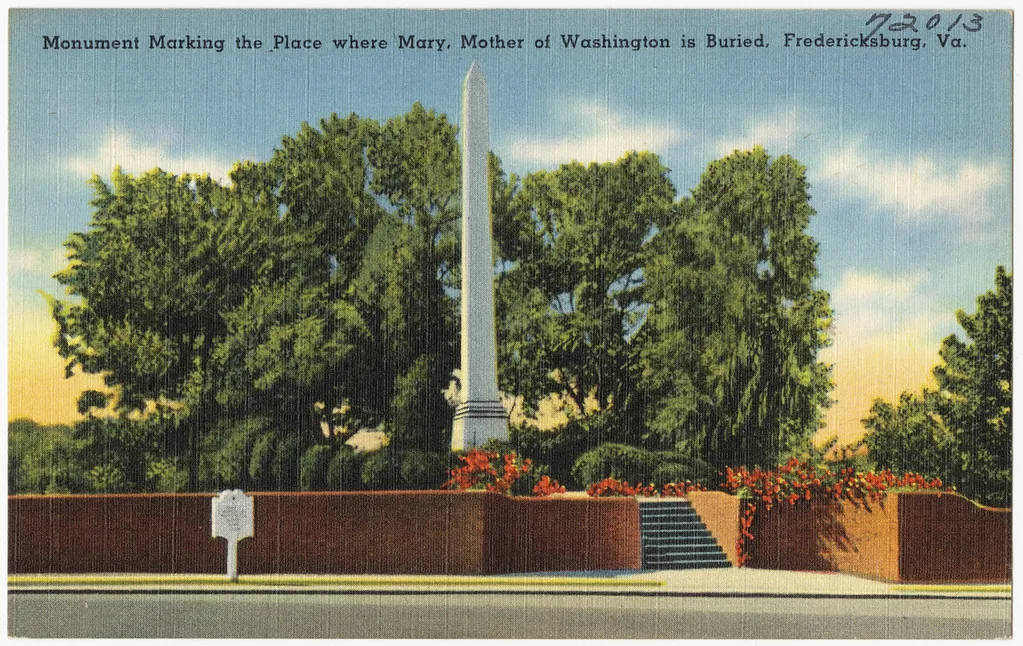
Fredericksburg built a monument to George Washington's mother. Not to George — to Mary.
Mary Ball Washington was born sometime between 1707 and 1709 at a plantation in Lancaster County, Virginia. Her father died when she was three; her mother died when she was twelve. She inherited property and slaves and was placed under the guardianship of a lawyer named George Eskridge. In 1731, at age twenty-three, she married Augustine Washington, a planter who had recently returned from England to discover his first wife had died. Mary brought at least 1,000 acres of inherited property to the marriage.
They had six children: George, Elizabeth, Samuel, John Augustine, Charles, and Mildred, who died as an infant. When Augustine died in 1743, George was eleven. Unlike most widows in Virginia at the time, Mary never remarried. She managed Ferry Farm — 276 acres — with help from others, well beyond the age when her eldest son came of age.
When George was fourteen, his older half-brother Lawrence arranged for him to become a midshipman in the Royal Navy. Mary's half-brother Joseph Ball wrote her advising against it, saying the Navy would "cut and staple him and use him like a negro, or rather, like a dog." George stayed home.
Three of Mary's sons — Samuel, John Augustine, and Charles — served in the Virginia Militia during the Revolutionary War. Her son-in-law Fielding Lewis ran the Fredericksburg Gunnery, which made muskets for American forces and nearly bankrupted him. During the war, Mary met the Marquis de Lafayette at her home in Fredericksburg; the two maintained a warm relationship for the rest of her life. A legend claims she was a Loyalist sympathizer. There is no credible source for that.
George purchased a house for her in Fredericksburg in 1772, two blocks from Kenmore, where her daughter Betty lived. She lived there from 1772 until her death. After learning he had been elected president in April 1789, George traveled from Mount Vernon to visit her. She was suffering from breast cancer. It is said that she told him of her poor health and expected to die soon, and that George said he would need to decline to serve as president. The story goes that Mary responded: "But go, George, fulfill the high destinies which Heaven appears to have intended for you for; go, my son, and may that Heaven's and a mother's blessing be with you always."
She died of breast cancer on August 25, 1789. She is buried near Meditation Rock in an unmarked grave on the grounds of the Kenmore plantation. The exact location is unknown.
A monument was erected to her in 1833 and dedicated by President Andrew Jackson. It was left unfinished. In the late nineteenth century, the National Society Daughters of the American Revolution raised money to complete it. The new memorial was dedicated by President Grover Cleveland in 1894 near her possible grave site.
The University of Mary Washington is named for her. So is the hospital. In 2019, the minor league baseball team introduced a logo of Mary Washington's silhouette — the first female logo, they said, to be part of a team's permanent branding. Fredericksburg remembers the mother.
- ·1201 Washington Avenue. Mary Ball Washington's burial site — George Washington's mother, who spent the last 17 years of her life in Fredericksburg. First monument attempt: a cornerstone was laid in 1833 at a ceremony attended by President Andrew Jackson, but the project was abandoned. The current 40-foot granite obelisk was completed and dedicated in 1894 by the Mary Washington Monument Association. Distinct from Mary Washington House (her residence, ~4 blocks away on Charles Street).
Memories
Editorial content compiled with AI assistance. Place details verified against public records.