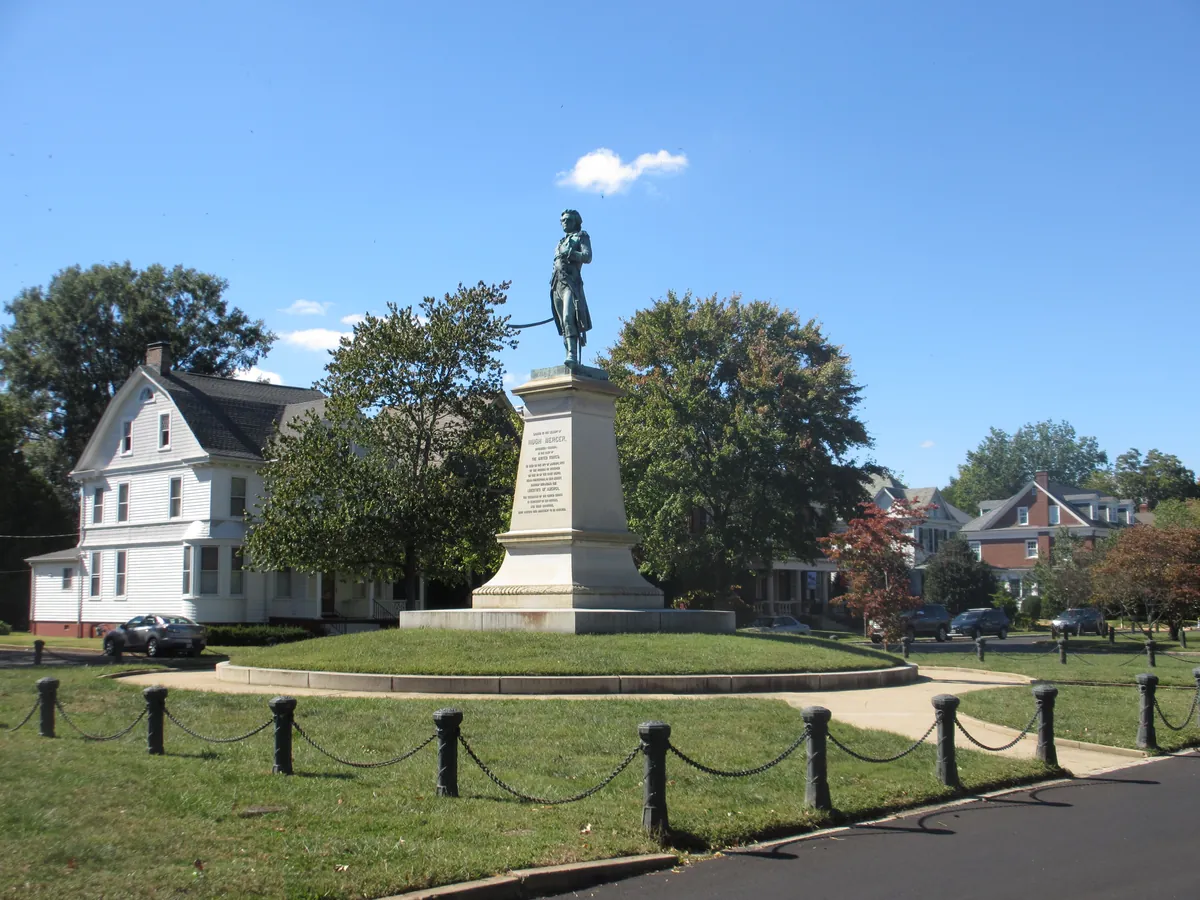
Washington Avenue ends at the burial place of Mary Washington. In 1789, the president's mother was buried on her daughter's estate, on land that would become Kenmore. A monument was raised there in 1893, and the avenue itself, by then, had been given over to commemoration and residence. The district was listed on the National Register in 2002.
Kenmore anchors the southern end—the 1770s Georgian mansion built for Betty Washington Lewis and her husband Fielding, itself a National Historic Landmark. Around it, beginning in the 1890s, the city's merchants and professionals built houses in the styles then current: Italianate, Queen Anne, Shingle, Colonial Revival. The Samuel W. Somerville House went up in 1896–97. The Shepherd House was completed in 1910–11. The Mary Washington Monument Caretaker's Lodge, finished in 1896, stands near the monument itself.
Three more commemorative works followed. The General Hugh Mercer Monument, sculpted by Edward Virginius Valentine, was dedicated in 1906. The George Rogers Clark Memorial was placed in 1929. The Jefferson Religious Freedom Monument came in 1932.
It's a narrow district—four blocks of formal boulevard with monuments, one cemetery, thirty-six houses. The structures that hold the Register status are those that were built, not those that were later added. What remains is the work of people who meant to live well, and to live where mourning had already made the ground significant.
- ·NRHP 2002. Kenmore and the Confederate cemetery are nearby anchors.
Memories
Editorial content compiled with AI assistance. Place details verified against public records.