The Ohlone, Esselen, Salinan, and Chumash peoples had been working this coastline for at least twelve thousand years before any European ship appeared on the horizon. They knew what the place offered: one of the most productive marine environments on the continent. Shellfish, fish, the Pacific's cold upwelling — everything that draws the eye and fills the net. The bay was not waiting to be discovered. It was already in use.
The Spanish arrived slowly. A Portuguese captain sailing under the Spanish flag, Don Juan Rodríguez Cabrillo, mapped the coast in 1542 but the water ran too rough to land. He named the place La Bohia de los Pinos — the bay of the pines — for the forests along the shore and sailed on. A second expedition under General Sebastián Vizcaíno came in 1602. Then nothing for over a century and a half. The actual founding of Monterey arrived in the spring of 1770, a joint land-and-sea operation: Fray Junípero Serra aboard the *San Antonio*, Gaspar de Portolá leading the overland column. They converged at the bay on May 24, established a presidio and mission, and on June 16 consecrated the first church. California had its capital.
For the indigenous people, Spanish settlement meant forced labor, epidemic disease, and the violent dismantling of cultures that had persisted for millennia. The missions baptized and conscripted. Smallpox and measles moved through communities that had no immunity. What survived did so in the margins — in arrowheads that retained their pre-contact form but were knapped from glass and metal, in traditions maintained despite suppression, in organized resistance. At the Santa Cruz Mission, an Ohlone woman named Yaquenonsat — holding rank within both her community and the mission — arranged the assassination of a padre with a documented history of sexual violence against indigenous women. This history is part of what Monterey is built on, and the descendant communities of the central coast have never fully left.
Monterey itself held capital status through Spanish rule and Mexican governance, accumulating the infrastructure of a seat of power. The Custom House — the oldest government building in California — still stands. In 1849, Monterey hosted California's first constitutional convention, the meeting that set the state on its path toward statehood. By then the center of political gravity had already moved north, and Monterey was left to find another purpose.
It found several. The sardine industry turned the waterfront into something relentless and productive — canneries running around the clock, the bay harvested at industrial scale. John Steinbeck grew up watching this, and what he saw became *Cannery Row*: the workers, the stink, the beauty and the wreckage of it. Robert Louis Stevenson had already passed through, writing about the region's peculiar quality of light and isolation. Writers came here because something about the place resisted the comfortable and the easy. The sardines eventually ran out — the industry collapsed mid-century — but the Monterey Bay Aquarium now occupies one of the old canneries, and the marine sanctuary that surrounds the bay is among the largest protected ocean environments in the country.
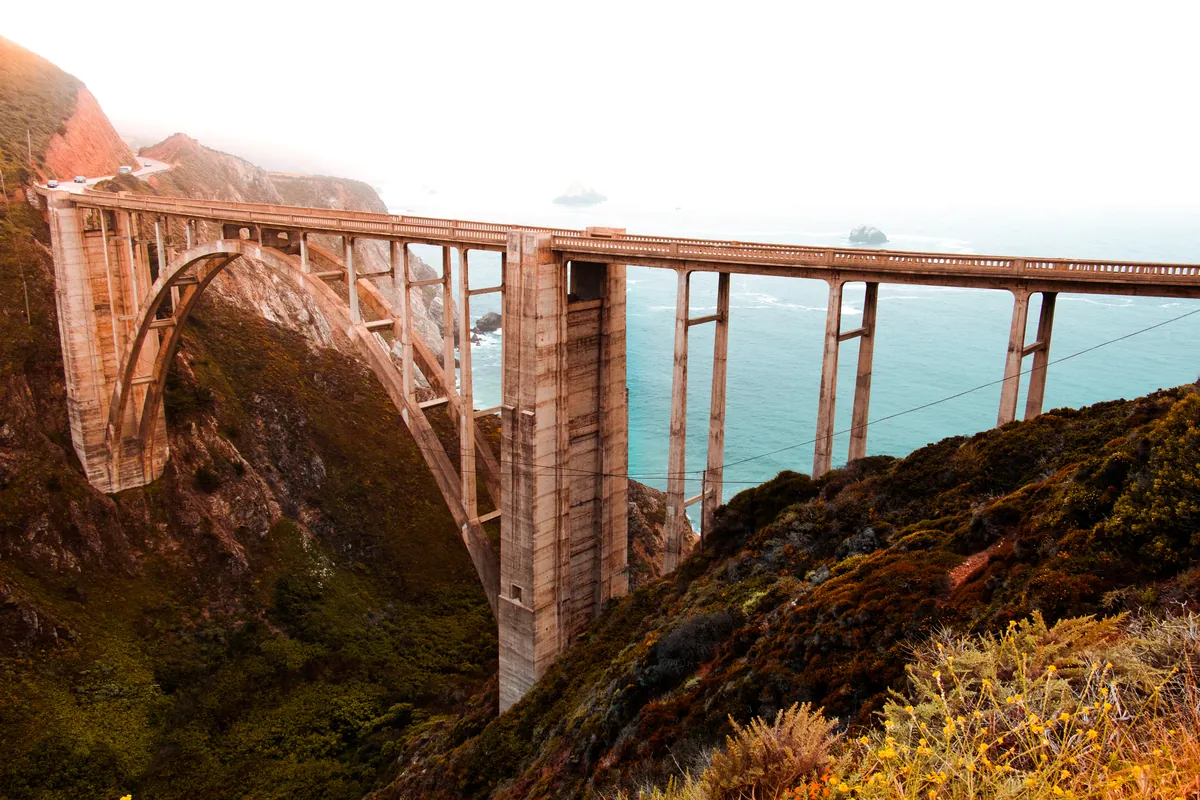
South of the city, Highway 1 narrows and the Santa Lucia mountains press the road against the Pacific cliff. This is Big Sur — rugged, sparsely populated, resistant to domestication. Artists and writers found it specifically because it offered no amenity and asked for nothing. The coastline that made it difficult to settle is the same coastline that kept it intact. What the Spanish couldn't easily reach, the twentieth century couldn't easily ruin. The whole stretch from Monterey south operates on this principle: the geography that made things hard is precisely what was worth saving.