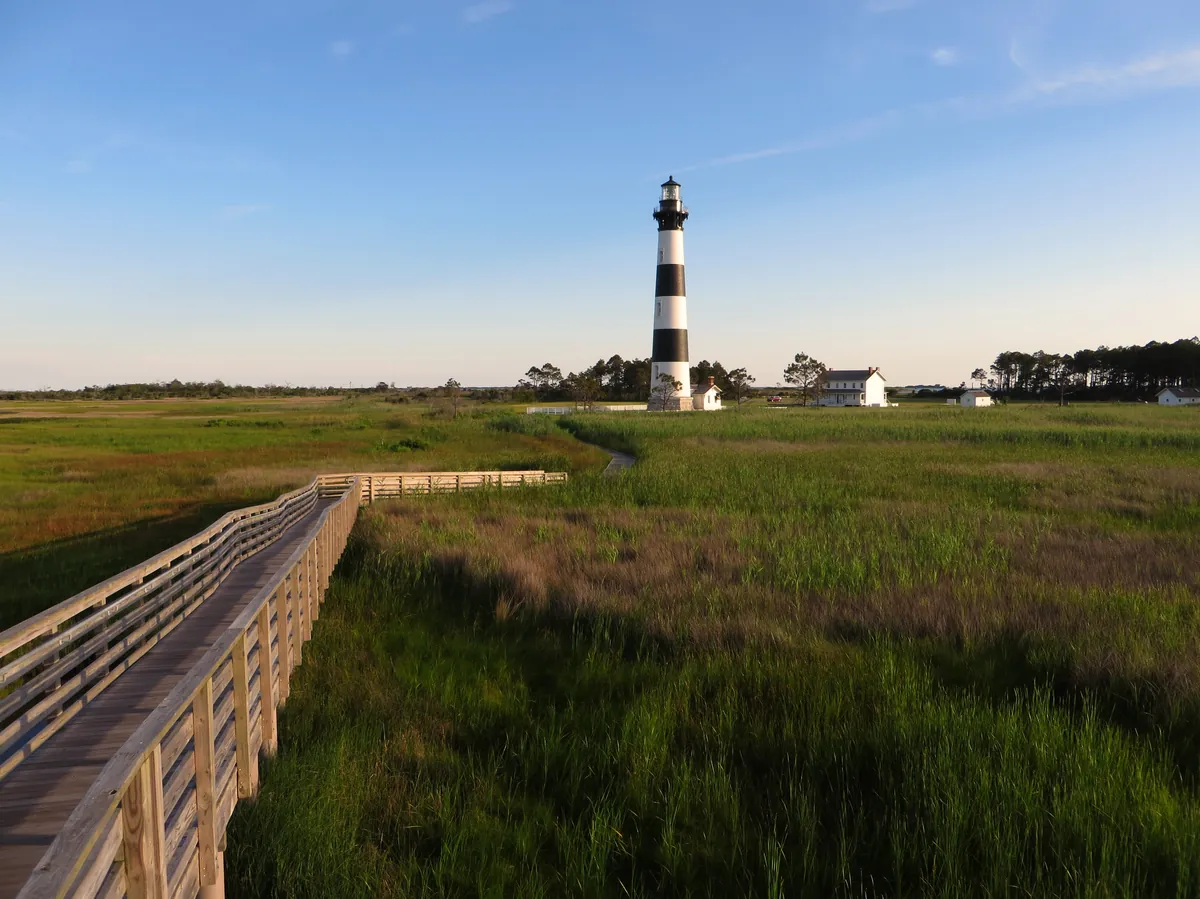
The Outer Banks did not form so much as accumulate — 200 miles of barrier islands and spits built from glacial remnants, sand dunes that survived the melting ice and reconstituted themselves into a thin membrane between the Atlantic Ocean and the sounds of coastal North Carolina. The land here is not stable. It drifts. Inlets open during storms and close over decades. Hatteras Island, by 2014, had eroded to 25 percent of its original width in places. Whatever was built here was built on something that had no intention of staying put.
That instability shaped everything. Before the first bridges went up in the 1930s, the only way on or off the islands was by boat, which meant the communities that took root here developed in near-isolation from the mainland. That isolation preserved something: a maritime culture, and a distinctive brogue — thicker the further south you travel, thickest on Ocracoke — that sounds, to American ears, closer to English than to anything from the continent. The Outer Banks produced a people made by the sea, cut off enough from the interior that they had to make their own way.
The Algonquin-speaking peoples — Chowanoke, Secotan, Poteskeet — had already worked that calculation. They fished the Atlantic-facing barrier islands in summer and retreated to Roanoke Island and the mainland in winter. Europeans arrived in 1584 with the first English attempt at colonization on Roanoke Island, and brought with them the diseases that dismantled what the indigenous inhabitants had built. The colony that followed vanished — Manteo and Wanchese, the two Croatoan and Roanoke figures who crossed to England and returned, are among the last documented presences before the settlement disappeared entirely from the record. What the English left behind was a mystery that has never been solved.
What came after was harder and stranger. Some residents made their living as wreckers — scavenging ships that ran aground on the shoals, and occasionally luring them aground with lanterns tied to horses, mimicking the motion of a vessel in safe water. The shoals around the Outer Banks were treacherous enough on their own: the surrounding seas earned the name Graveyard of the Atlantic. Blackbeard — Edward Teach — used Ocracoke as his last refuge, and it was there he was killed on November 22, 1718, in a battle with Virginia troops. During World War II, German U-boats worked the same waters, sinking Allied supply ships in such numbers that the stretch briefly acquired another name: Torpedo Junction. The U-85, the first German submarine sunk by the U.S. Navy, went down off Cape Hatteras. Bodies and cargo washed ashore. Citizens lived under mandatory blackouts. The sea gave and the sea took, and the people on these islands had learned not to be surprised by either.
Then, on December 17, 1903, on the dunes at Kill Devil Hills, Orville and Wilbur Wright flew a powered, heavier-than-air machine for twelve seconds. They had come from Dayton, Ohio, and they chose this place for its wind and its open ground. The event did not immediately transform the islands. The bridges came later, in 1930, and with them the slow conversion of a fishing and maritime economy into something built around visitors. Commercial fishing — which had expanded dramatically after the construction of the Albemarle and Chesapeake Canal opened shipping routes in the mid-19th century — gave way by the 1990s to a service economy driven by tourism.
What the Outer Banks made is a place that keeps refusing to be fixed in place — literally, as the sand migrates and the sea rises, and culturally, as each generation inherits a landscape that demands adaptation. The land here has always been temporary. The people learned to work with that, or they left.