Pine Mountain & Warm Springs
FDR's polio cure became a place. The Little White House, the healing springs, the gardens — Georgia never forgot what it meant to him.
The Pine Mountain Range is a geological anomaly — a ridge that rises to 1,395 feet at Dowdell's Knob, making it among the highest elevations at this latitude anywhere in the eastern half of the continent. It has nothing to do with the Appalachians, which terminate farther north. The Pine Mountain terrane is its own thing, a distinct formation that runs northeast through Harris and Meriwether counties and drops abruptly where the Flint River cuts through it at Sprewell Bluff. The springs that flow from the north side of Pine Mountain are equally anomalous — warm, mineral-rich water at a steady 88 degrees, year-round, the strongest outflow of any springs in the region. The land here does something unusual, and people have noticed for a long time.
The Creek moved through this country before European settlers arrived, and accounts say they regarded the springs as healing waters. A settler named David Rose built the first resort on the site in 1832; it burned in 1865 and was rebuilt. By 1893, Charles Davis had constructed the 300-room Meriwether Inn, with a bowling alley and tennis courts, drawing visitors from across the South. Train travel at the end of the century brought more of them. The town that grew up around those springs was called Bullochville — incorporated in 1893, its land largely owned by the Bulloch family, who ran a grist mill, a cotton gin, a bank, and the springs themselves across nearly 2,000 acres.
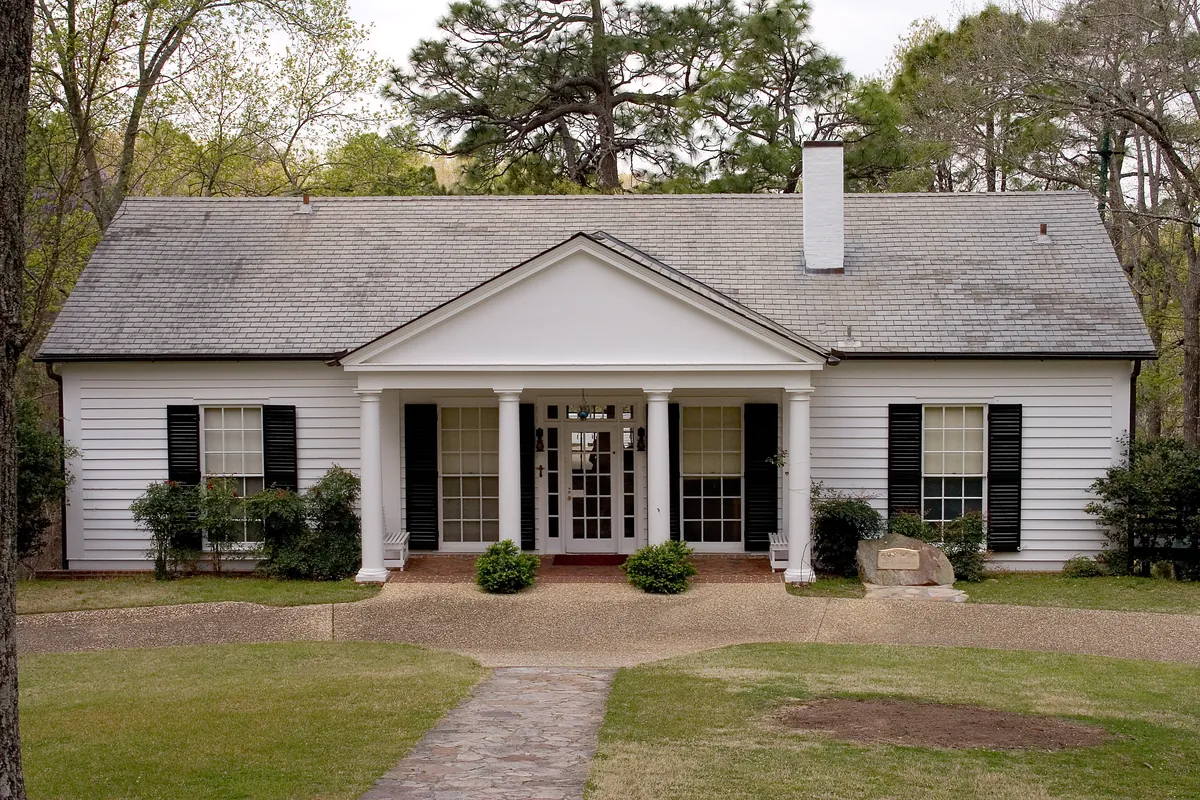
Then, in October 1924, Franklin Roosevelt arrived. He had been partially paralyzed by polio three years earlier and came looking for what the waters might do for him. The springs did not cure him. But the exercise helped, and he found something in the rural community and the landscape that kept pulling him back. He liked the place enough that he renamed it — Bullochville became Warm Springs that same year. He began purchasing property in 1926, eventually assembling over 1,200 acres. In 1927 he incorporated the Georgia Warm Springs Foundation to provide therapeutic treatment for other polio patients. In 1932, while serving as governor of New York, he built a small house on his Georgia property — the only home he ever owned. He was elected president that year. At Dowdell's Knob, the high point of the ridge above his house, he had a brick oven and picnic area constructed for use during his stays.
The Little White House was where Roosevelt developed much of the New Deal plan and deliberated wartime strategy during World War II. He died there on April 12, 1945. F.D. Roosevelt State Park, built along the Pine Mountain ridge, is now the largest state park in Georgia — a living record of the years he spent here, the land he assembled, and the knob where he came to think.
What the springs produced, finally, is this: a small town of around 450 people that holds a disproportionate piece of American history, surrounded by the largest state park in Georgia, on a ridge that shouldn't be as high as it is this far south. The anomaly of the geology made the springs. The springs made the town. The town made a president's only home.