Good forOutdoor lovers
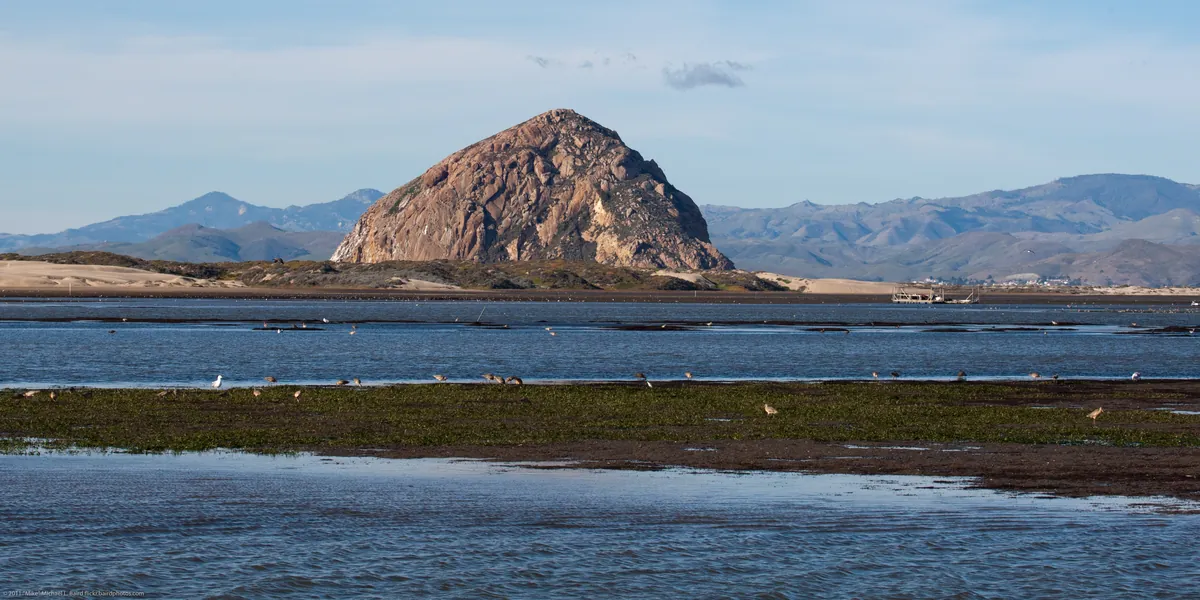
The 581-foot volcanic plug at the mouth of Morro Bay harbor has been a navigational landmark, a quarry, and a sacred site — sometimes all at once. The Salinan people hold the established right to climb it for their solstice ceremonies; the Chumash consider it too sacred to climb at all. Quarried on and off from 1889 to 1969 for breakwater stone, it is now California Historical Landmark No. 821 and a protected nesting site for peregrine falcons. The general public cannot climb it. You can drive to its base and look up.
Quick facts
- ·The Chumash name for Morro Rock is Lisamu' (also transliterated Lisamu) and the Salinan name is Lesa'mo' (also transliterated Le'samo/Le'samo). Both tribes regard the rock as sacred. (Confirmed independently by KQED and Wikipedia.)
- ·The Chumash believe Morro Rock should never be climbed; the Salinan have a tradition of climbing it, historically tied to solstice ceremonies, and the two tribes disagree over the rock's territorial/cultural ownership and over whether it should be climbed at all — this disagreement continues today. (Confirmed by KQED and Wikipedia; note this is a dispute over territorial claim/climbing rights, not a dispute over a shared myth.)
- ·A Salinan legend holds that a hawk and a raven destroyed the two-headed serpent-monster Taliyekatapelta, which had wrapped its body around the base of the rock; this legend underlies the Salinan tradition of ceremonially climbing the rock. (Confirmed by Wikipedia and Weird California; this legend is attributed specifically to the Salinan, not documented as a shared Chumash creation myth.)
- ·Starting in 1889, the U.S. Army Corps of Engineers quarried Morro Rock on and off for roughly 80 years (commonly cited as 1889 to 1969), blasting an estimated 250,000 tons of rock from it, which was used to build breakwaters at Morro Bay and in the Port San Luis/Avila Beach area. (Directly confirmed by KQED; duration/dates also corroborated by Wikipedia.)
- ·In 2021, the Army Corps of Engineers contacted Chumash representatives and told them it had found a way to extract some of the quarried stone blocks from the breakwater and return them. (Directly confirmed by KQED: 'in 2021, they contacted the Chumash...and told them they'd found a way to extract some of Morro Rock's stones from the breakwater and return them to the tribe.')
- ·On August 20, 2022, the Northern Chumash Tribal Council held a ceremony called 'Reunite the Rock' at the base of Lisamu' (Morro Rock), in which tribal members arrived via traditional wooden canoes (tomols) and hundreds of participants formed a human chain to pass recovered rock fragments to the rock's base. (Directly confirmed by KQED, corroborated by Paso Robles Daily News reprint of the Northern Chumash Tribal Council announcement and general web search results.)
More archive
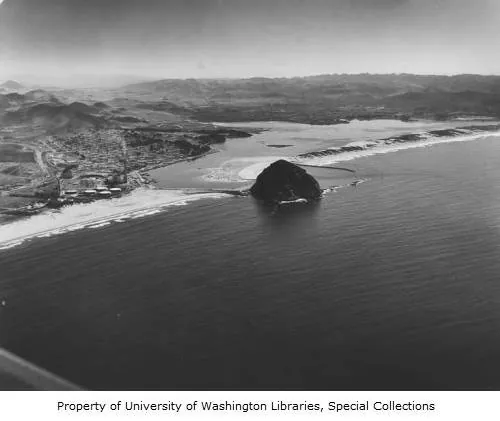
3 historical photographs.
Memories
Be the first to leave a memory at Morro Rock.
Sign in to see memories your family has left at this place.
Editorial content compiled with AI assistance. Place details verified against public records.