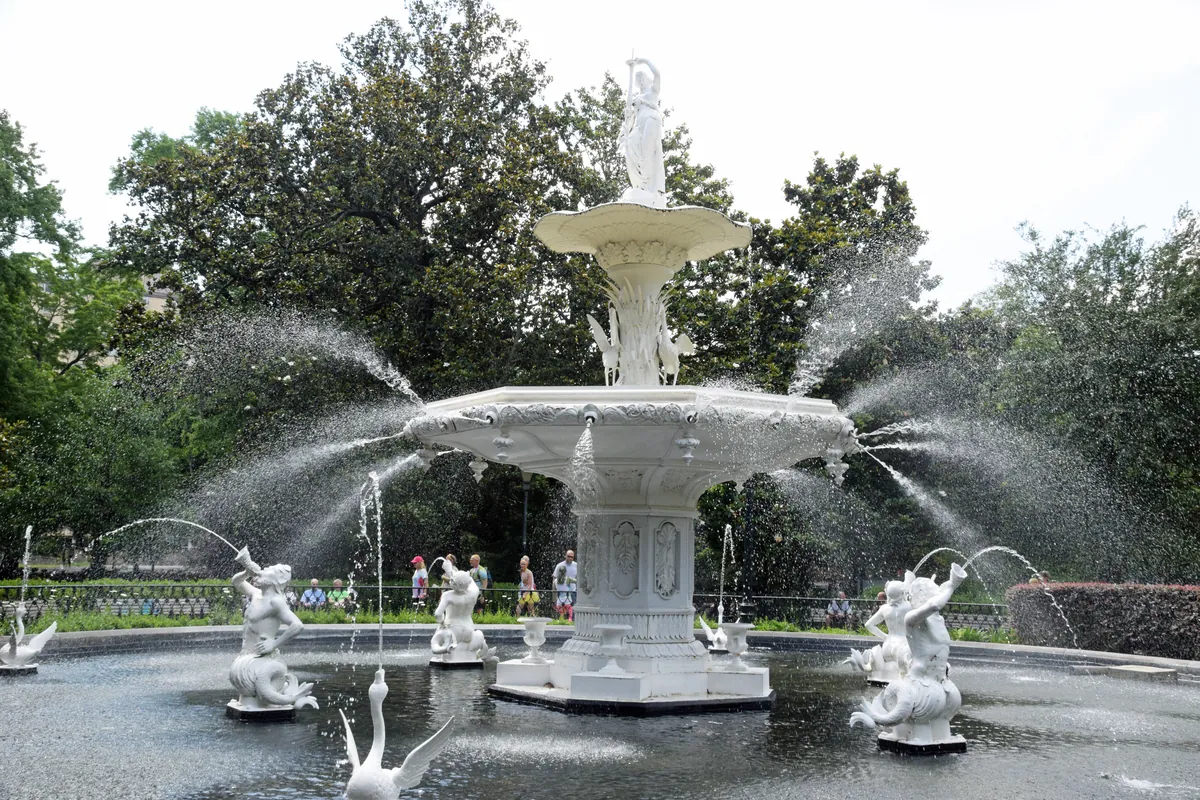
Savannah sits on the Savannah River twenty miles upriver from the Atlantic, at a bluff high enough to command the approach from the sea and close enough to the Georgia interior to pull its wealth outward. That position was not an accident. It was a plan.
On February 12, 1733, General James Oglethorpe landed at Yamacraw Bluff with settlers from the ship *Anne*. They were met there by Tomochichi of the Yamacraw and by the traders John and Mary Musgrove, who interpreted between the two parties. What Oglethorpe laid out on that bluff was not just a settlement but a geometry: a grid of streets interrupted at regular intervals by open squares, a pattern now called the Oglethorpe Plan. Twenty-two of those squares survive. The plan predates the city's buildings, its politics, its wars — and it outlasted all of them.
By the eve of the American Revolution, Savannah had grown into the southernmost commercial port in the Thirteen Colonies. It fell to British troops in 1778 and held through a failed siege the following year — American and French forces, including Haitian soldiers recruited from the French colony of Saint-Domingue, could not dislodge the British garrison. The city remained in British hands until July 1782. Franklin Square today holds a monument to those Haitian soldiers, one of the few black regiments to fight on the American side in the Revolutionary War.
Cotton made the next century. Georgia's climate suited it, the plantation system produced it in volume, and the Port of Savannah shipped it out. The city became the Confederacy's sixth most populous by the time of the Civil War, and Major General William T. Sherman made it the terminus of his March to the Sea. Local authorities negotiated a peaceful surrender on December 21, 1864, sparing the city from the destruction Sherman had left elsewhere. That decision — to yield rather than burn — preserved what Oglethorpe had drawn: the squares, the streets, the antebellum buildings that now constitute one of the largest National Historic Landmark Districts in the United States, designated in 1966.
The institutions Savannah built alongside its commerce are what distinguish it. The Georgia Historical Society, the oldest continually operating historical society in the South, is here. So is the Telfair Academy of Arts and Sciences, one of the South's first public museums. The First African Baptist Church, one of the oldest African-American Baptist congregations in the country, stands in the same city as Temple Mickve Israel, the third-oldest synagogue in the United States — a Jewish community that dates to the colony's first year, 1733. The Central of Georgia Railway roundhouse complex, the oldest standing antebellum rail facility in the country, is here too. Flannery O'Connor was born here and lived in the city until she was fifteen. Johnny Mercer, the songwriter, was a native Savannahian. John Berendt set *Midnight in the Garden of Good and Evil* in its downtown, and the book put the city's particular atmosphere — its squares, its eccentrics, its sense of time moving differently — in front of a generation of readers.
The port that financed all of this still operates. It has grown into one of the largest container facilities in North America. The Oglethorpe Plan still organizes the city's center. Savannah chose to survive intact, and what that choice preserved is the argument for visiting it.