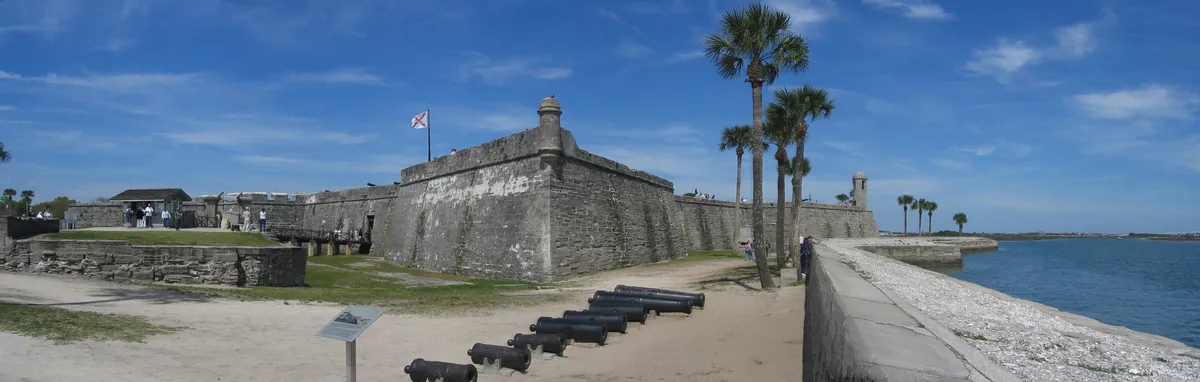
St. Augustine sits on a narrow strip of Atlantic coast in northeastern Florida, wedged between the Matanzas River and the sea. It is not a commanding position — no great harbor, no mountain pass, no river mouth wide enough to anchor an empire. What the site offered in 1565 was something more specific: a shallow inlet, a defensible bay, and proximity to the Gulf Stream shipping lanes that carried Spanish treasure back to Europe. Pedro Menéndez de Avilés understood the geometry. The French, already dug in up the coast at Fort Caroline, threatened those lanes. Menéndez was sent to remove them.
He landed on September 8, 1565 — the feast day of St. Augustine of Hippo, which is how the settlement got its name — in the former Timucua village of Seloy, whose inhabitants had farmed, fished, and maintained trade networks along the St. Johns River long before any European had seen the coast. Menéndez planted a flag, accepted a formal welcome, and within days had marched his troops overland to Fort Caroline. The French garrison was lightly defended; most of its fighting men were at sea with the fleet. The Spanish overwhelmed it. When the French naval forces came ashore to the south, survivors and all, Menéndez accepted their surrender and executed them at what is now known as Matanzas Inlet — the Spanish word for "slaughters." The inscription left on the bodies at Fort Caroline read: hanged not as Frenchmen, but as heretics. The brutality was doctrinal, not incidental. This was how Spain meant to hold Florida.
Holding it proved harder than taking it. Sir Francis Drake sacked and burned the settlement in 1586. The English buccaneer Robert Searle sacked it again in 1668, killing sixty people and pillaging storehouses and churches. It was Searle's raid — combined with the establishment of an English settlement at Charles Town — that finally persuaded the Spanish Crown to spend real money on the city's defense. Construction on the Castillo de San Marcos began in 1672. Built from coquina, the local shellstone that absorbed cannonballs rather than shattering under them, the fort was completed in 1695. When British forces from Carolina laid siege in 1702, they held for 58 days and failed. When General Oglethorpe came back in 1740, he failed again. The Castillo had changed the calculus of the entire southeastern coast.
What happened inside those walls, and in the city the fort protected, was more complicated than military history usually admits. In 1738, the Spanish governor established Fort Mose two miles north of St. Augustine — the first legally recognized free Black settlement in what is now the United States. Enslaved people who escaped from the English colonies to the north and pledged loyalty to Spain and converted to Catholicism were granted their freedom. Fort Mose functioned as a military buffer and a community; archaeological evidence shows the layout of homes alongside fortifications. A century and a half before the Civil War, St. Augustine was already the terminus of what one account calls the first underground railroad.
The city changed hands twice — to Britain in 1763, back to Spain in 1783 — and each transfer reshuffled its population without erasing its Spanish bones. The street grid survived. The narrow lanes survived. The Franciscan headquarters at St. Francis Barracks survived. When Henry Flagler arrived in the winter of 1883, he found a city with genuine historical character and, by his assessment, inadequate hotels. Flagler had made his fortune as co-founder of the Standard Oil Company. What he did with it in St. Augustine was transformative: he built the Hotel Ponce de Leon and the Hotel Alcazar, hired the architectural firm Carrère and Hastings to design them in the Spanish Renaissance Revival and Moorish Revival styles, and assembled the Florida East Coast Railway to bring wealthy northerners south. The Ponce de Leon was among the nation's first electrified buildings. With its opening in 1888, St. Augustine became, briefly, the winter resort of American high society. Flagler eventually extended his railroad to Palm Beach and Miami, and the social elite followed the tracks south. But the city he had ornamented remained.
In the spring and summer of 1964, St. Augustine became the site of some of the most consequential civil rights demonstrations in the country. Local leader Robert Hayling had spent years organizing against segregation and Ku Klux Klan violence; he asked Martin Luther King Jr. and the Southern Christian Leadership Conference for help. King was arrested on the steps of the Monson Motor Lodge on June 11, 1964 — the only arrest of his career in Florida. Days later, Black and white protesters jumped into the hotel's segregated swimming pool. The manager poured muriatic acid into the water to force them out. A photograph of that moment, and of a police officer jumping in to make arrests, ran on the front page of a Washington newspaper the day the Senate voted on the Civil Rights Act of 1964. The demonstrations in St. Augustine, and the violence they exposed, were a direct factor in that bill's passage.
The Castillo de San Marcos still stands. The Ponce de Leon hotel is now Flagler College, a four-year liberal arts institution founded in 1968. The street grid Menéndez's settlers laid down in 1565 is still the street grid. This is a city that has been burned, sacked, besieged, transferred between empires, and photographed into infamy — and has kept its shape through all of it. The shape is the story.