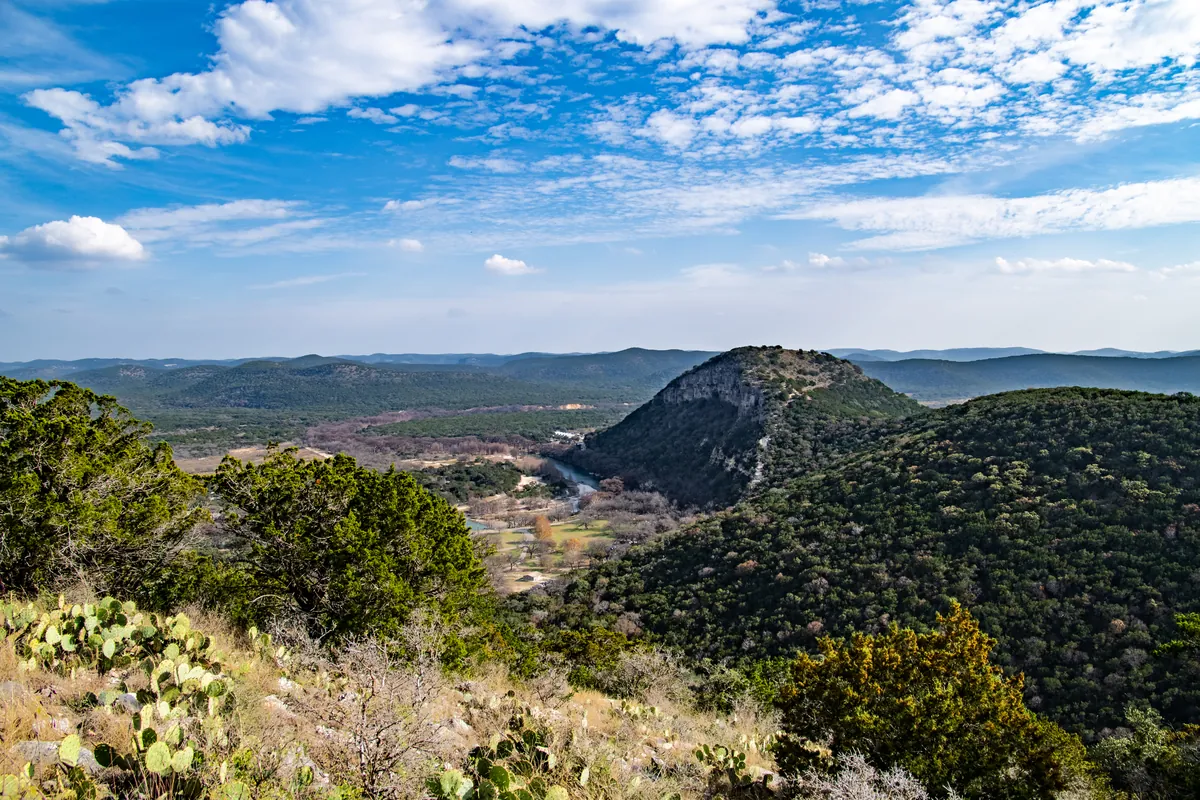
The Edwards Plateau does not announce itself gently. East of the Balcones Escarpment, the land lies flat, coastal, predictable. Then the fault line hits and everything fractures — limestone ridges, sudden elevation, rock breaking through the thin skin of soil. This is not a landscape that accumulated; it is one that eroded, the surrounding material falling away over millions of years until what remained were hills made not by uplift but by persistence. The terrain the Hill Country presents today is what survived.
That survival required water. The karst limestone beneath the plateau dissolves, carves, and stores — a slow underground economy of springs and aquifers that discharged along the Balcones Escarpment and made permanent settlement conceivable long before any settlers arrived. Archaeologists have found evidence of human occupation in parts of the Hill Country going back 10,000 years. People came for the springs, and they came for the flint — Edwards Chert, pulled from rocky outcrops and riverbeds to make tools that lasted and could be repaired. The Spanish encountered the stone, called it *pedernales*, and named the river after it. The land was already a place before anyone drew a map of it.
What made the modern Hill Country was a collision of cultures that shouldn't have worked and produced something specific. Between 1840 and 1850, settlers from the southern mountain states — Tennessee, Arkansas, Missouri — moved into the hills in significant numbers, drawn by terrain that resembled what they knew. Simultaneously, the Adelsverein, a German Society of Nobles, introduced German settlers into a corridor running a hundred miles northwest from New Braunfels and San Antonio through Fredericksburg to Mason, along the axis of an old Indian route. By 1870, Gillespie County was 86 percent German, Comal 79 percent. Towns like Fredericksburg, Comfort, Boerne, and Mason bore that imprint in their architecture, their churches, their farming practices. The accordion arrived with these settlers; it eventually migrated into Tejano music and became one of that tradition's defining instruments — a detail that says more about how the Hill Country actually worked than any formal history could.
The German settlers brought something else: a stubborn political independence. During the Civil War, the heavily pro-Union German population opposed Texas secession. For the three-quarters of a century following Reconstruction, Gillespie and Kendall Counties backed Republican presidential nominees in a state that was otherwise one-party Democratic. In 1924, Comal County gave 73.96 percent of its vote to the Progressive insurgency of Robert La Follette — his best county in the nation — making it and Gillespie the only counties south of the Mason-Dixon line to give him a plurality. This was not a region that moved with the current.
The land itself enforced a certain character. The thin topsoil and exposed rock made conventional agriculture a negotiation rather than a given. The rivers — the Pedernales, the Llano, the Guadalupe, the Frio — carved the valleys but could not be trusted. Flash flooding comes fast here; the karst topography offers no buffer, and the region earned the name Flash Flood Alley honestly. What the land would support, it supported abundantly: the same geology that makes farming difficult produces conditions for viticulture, and the Hill Country now anchors three American Viticultural Areas, including the Texas Hill Country AVA and the Fredericksburg in the Texas Hill Country AVA. The wine industry grew out of the same limestone that defeated other ambitions.
What those forces made together — the geology, the water, the convergence of southern Appalachian and Central European settlers, the political independence, the resistant terrain — is a region that carries a genuinely mixed cultural inheritance: English, Spanish, and German threaded through the food, the music, the architecture, in combinations that don't quite match any other part of Texas. The Hill Country is where the American South ends and the Southwest begins, geographically and in every other sense. The line runs right through it.