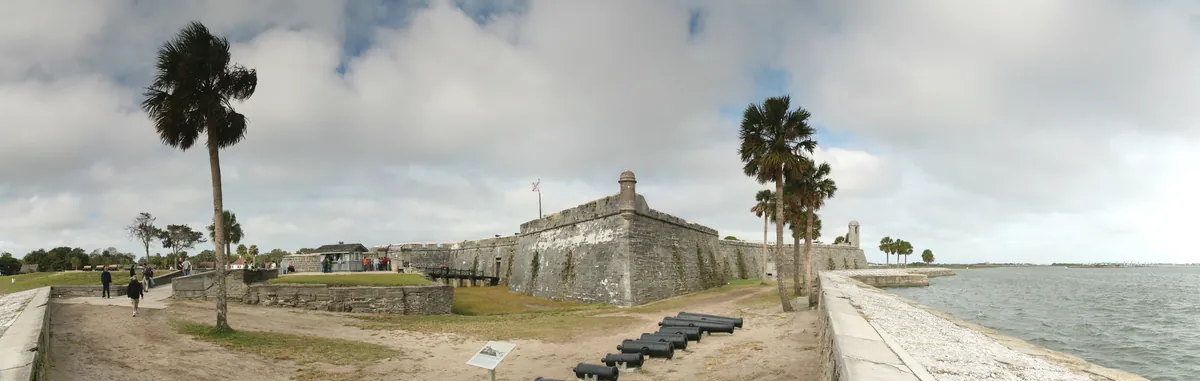
The Spanish started building it in 1672, and they built it out of coquina — a sedimentary stone made of compressed ancient shells that absorbed cannonballs rather than shattering under them. That material decision is why the Castillo de San Marcos is still standing. When English colonial forces under Carolina Governor James Moore laid siege to it in 1702, they burned the surrounding city but couldn't breach the walls. The same result held in 1740 when James Oglethorpe brought a British fleet and bombarded it for 27 days. The fort never fell by force, across five different flags.
What happened inside those walls is harder to hold. The Spanish used enslaved African labor to build it, and later freed fugitive slaves escaping British Carolina — directly seeding the first free Black settlement in what would become the United States. Under American control, it became a prison for Seminole and Plains Indian leaders. The Ledger Art tradition originated here, among prisoners with little else. Construction began in 1672. It's still there on the bayfront of St. Augustine. Go.
- ·On the night of May 28-29, 1668, English pirate/privateer Robert Searle led a raid on St. Augustine. A Spanish corporal, Miguel de Monzón, was out fishing when he spotted the approaching raiders, was shot twice as he tried to raise the alarm, but reached the garrison and woke the soldiers — nearly preventing the attack. (Source: bayfrontmarinhouse.com/blog/866-2, corroborated by independent secondary accounts of the same page content; direct WebFetch of the page returned empty content, so confidence rests on convergent search-indexed snippets of that source rather than a directly rendered page.)
- ·Searle's raiders burned part of the town, looted silver and other valuables, and held the daughters of wealthy families for ransom. They also carried off Black and Native American residents to sell into slavery in the Caribbean. Roughly 60 residents were killed. Governor Francisco de la Guerra y de la Vega, together with soldiers, held the existing wooden fort and prevented its capture, but could not stop the sack of the town. (Source: bayfrontmarinhouse.com/blog/866-2, corroborated by independent sources — thefloridasqueeze.com, gerard-tondu.blogspot.com — converging on the ~60 casualty figure.)
- ·The Searle raid is credited with prompting Spain to order a permanent masonry fortification. Construction of the Castillo de San Marcos began October 2, 1672, under royal engineer Ignacio Daza, and took approximately 23 years to complete, finishing in August 1695. It was built on a site that had previously held nine wooden forts (making the Castillo the 10th fort on the site), all of which had succumbed to rot, termites, storms, tides, or fire. (Source: nps.gov/casa/learn/historyculture/who-built-the-castillo.htm, directly confirmed; the '10th fort/nine wood predecessors' framing independently corroborated by multiple additional sources.)
- ·The coquina used to build the Castillo was quarried from a site on Anastasia Island commonly referred to as the 'King's Quarry,' consistent with independent sources (Florida State Parks, historic markers) describing the Spanish coquina quarries on Anastasia Island — though this specific quarry name does not appear on the cited NPS 'who-built-the-castillo' page itself, which only states coquina was 'the only stone native to the area.'
- ·In November 1702, English forces from Carolina under Governor James Moore Sr. besieged St. Augustine during Queen Anne's War, beginning November 10, 1702 (per the cited Wikipedia 'Siege of St. Augustine (1702)' article; the other cited NPS page gives November 8). Roughly 1,500 town residents and soldiers took shelter inside the still-unfinished Castillo. Moore's small cannon proved ineffective against the coquina walls, which were known to absorb rather than shatter under cannon fire (a property independently well-documented for the fort generally). Moore burned the town but could not breach the fort. The siege was lifted on December 30, 1702 (per Wikipedia; NPS gives December 26) after a Spanish relief fleet arrived from Havana. Moore retreated in disgrace, burning his own ships/boats before withdrawing. (Sources: en.wikipedia.org/wiki/Siege_of_St._Augustine_(1702) and nps.gov/casa/learn/historyculture/the-siege-of-1702.htm, both directly fetched; note the two cited sources disagree with each other by 2 days on both the start and end dates, so the specific day-level precision should be presented as approximate/per-Wikipedia rather than as settled consensus.)
More archive
Memories
Editorial content compiled with AI assistance. Place details verified against public records.